Yes, it's true. I've acquired more musical equipment. I also have to say my title is a bit misleading. It's not really been a new cabinet day since this acquisition took place over a few months. But let me start at the beginning.
I was watching a YouTube video that was reviewing the best 2X12 cabinet on the market (for the money.) It was a Harley Benton G212 Vintage cabinet that came stock with Celestion Vintage 30 speakers. It's sold through Thomann Music for $205 plus shipping of $33 from Germany. Here's the link:
https://www.thomannmusic.com/harley_benton_g212_vintage.htm
For any of my music gearheads, you know you can't even buy the Celestion speakers for that price, much less an equipped cabinet with speakers. I had been wanting a 2X12 cabinet to pair with my Genz Benz El Diablo 100 amplifier. This was the perfect cabinet so I ordered it. It was on backorder so I had to wait a month to receive it.
Looks great, right? However, there is something I forgot to mention. I personally hate Celestion Vintage 30 speakers. They sound unfocused, and have a weird high-mid spike. I just can not for the life of me EQ an amp properly with them. But I had a plan.
I took them out, and put up an ad on Craigslist. I said I was aiming to trade the speakers more than I was to sell. To be honest, musical instruments aren't selling on Craigslist right now so I didn't really have to worry about that.
However, there was one thing I ran into that I hadn't run into before. Usually when I would receive trade offers they would be pretty fair. This time around I was offered a whole lot of crap. I mean, it was stuff that wasn't even close to being worth my time. I won't go into details as it's pretty depressing, but I finally got the offer I had been looking for.
A musician up the road had what I really wanted. A pair of Celestion G12T-75 speakers. He agreed to come on over, and I tested out all the speakers. We were both happy, so the trade worked out for everyone.
So I installed the G12T-75 speakers, and I have to say it sounds awesome. To me the Celestion 75's are the sound of rock n' roll. I recently purchased my first seven string guitar. I have to say that the Genz Benz El Diablo 100 and the Celestion 75's are perfect for it. Not to mention that it's a great set-up for all my guitars.
So I am really excited for this purchase. Remember, I bought this new for $238 (U.S. dollars.) To buy the equivalent of this set-up I would have to purchase a Marshall 1936 cabinet which is now $799 new from Sweetwater. Here's the link:
https://www.sweetwater.com/store/detail/1936--marshall-1936-150-watt-2x12-inch-extension-cabinet
So yeah, this is by far a much better deal. I haven't had a chance to turn her up really loud yet, but one of these days I may drag my set-up outside to see just what she can do at full blast. If I turned the volume all the way up inside the house I'd probably kill the fish. And I really don't want to do that.
I look at life a bit differently, and like to post my weird thoughts. I like musicial instrument repair and woodworking. For trying to live a somewhat normal life, a lot of weird things happen to me. Instead of putting up with it, I post about it in this blog.
Showing posts with label amp. Show all posts
Sunday, October 27, 2019
Monday, April 15, 2019
I Accidentally Bought An Amp
So there I was. It was a Saturday. A nice Saturday. The kind of Saturday where a person would decide to drive around and visit pawn shops. I was visiting the last pawn shop of the day, Tampa Gun and Pawn. It's kind of funny that it's called that since they don't sell guns anymore.
Parking was tight. I couldn't pull in from the direction I wanted. So I turned down a street and turned around. I pulled in from the side street so I could pull forward and back in. I did just that and parked.
When I walked in I recognized the owner of the pawn shop. I said, "Hi," and he said, "You hit my sign." I looked at him like he had four heads. My first thought was, "Your sign is on the top of the building. How did I hit that?" So I looked outside and saw that he had placed brand new, "Tampa Gun and Pawn Parking Only" signs up in front of the individual parking spaces. Since I backed in I looked at my side mirrors, but not my rear view mirror.
I looked at the sign and yelled, "Shit!" I yelled it really loud too. I had bent the sign, but I didn't break it. The owner said, "Don't worry. You're only the second guy to hit it today. In fact, someone has hit it every day. Don't worry about it."
I spent a minute calming myself down. He calmly asked me "If I was looking for anything in particular?" I said, "I was just there looking at anything and everything." He said to, "Look around and let me know if you have any questions." So I looked around.
I was wandering around when I saw a guitar amplifier that I had never seen before. When I looked at it I just saw this big logo that said MEGA.
As I looked closer I saw that it was a Mega Amp by a company called Megatone. I pulled out my phone, and began searching the internet for any information I could find on it. The only thing I could find is that it was a T60R model, and it was made by a company called Fame.
I had worked in an independent musical instrument store where we had two Fame branded Strat copies come through. Those were made in the 1980's. One customer we had from South America said that Fame instruments were sold down there. I thought that made sense do to them copying famous models for markets that Fender didn't sell in.
What few reviews I found were from European owners. One reviewer said that he paid 107 Euros for his amp back in 2007. What reviews I could find were extremely positive. They also cleared up some confusion. If you notice the amp says, "Solo Tube Series" on it. I thought, "Is it a tube amp?" Well kind of. It has one 12AX7 preamp tube in it. So "one" meaning "solo" tube.
So I asked the owner of the pawn shop about it. Specifically "What would be the price on something like that?" He said he, "Never priced it because he couldn't find any information on it." I told him about the one reviewer paying $107 Euros for it in 2007. He said he, "Didn't know the exchange rate of the Euro."
He then proceeded to say, "Do you want to make me an offer I can't resist?" I said, "I don't know. I can be pretty cheap. Also, I would need one of my guitars to check it out." He then said something I didn't expect. He said, "How about $50? You can take it home, and if it doesn't work you can bring it back, and I'll give you your money back."
I thought about it. Well, I didn't exactly want to pay for the sign. So I thought, "Well, if I buy the amp he won't bug me about paying for the sign." So I bought the amp. But first I had to get it down. His place was packed with things so I had to stand sideways on four ladders. I then had to move a speaker off of it, get the amp down, and move the speaker back into the amp's place.
I found a tag on the amp that said 5-6-11. I asked him "If it had been there since 2011?" He said, "He was pretty sure it hadn't been sitting there that long. Nothing in the shop had."
So I finally managed to get the amp down. I paid $54 with tax for the amp. I put it in my truck and brought it home. I prayed that it worked since I didn't want to return the amp. So I plugged it in, and was shocked. Channel one sounded like a Fender Bassman. And not just that, but it sounded like a dang good Fender Bassman.
Channel Two had a flat EQ, but if you turned down the treble and bass, then maxed out the mids, it sounded a lot like a 70's Marshall 2203. (That's before they named it the JCM 800.) What made both channels neat is that they have pre-amp controls. They weren't just turn up the volume until your ears bleed, and then, and only then, you get great tone. The pre-amp controls let me achieve some great tone at a lower volume.
What was neat was that if you set Channel Two at a flat EQ, you could get a great blues tone. But you could also turn the gain up and really rock out. I have to say it was a surprisingly great amp, especially for $50. The EQ was extremely versatile.
So I had to open her up. One problem I noticed was that even though it was only a supposed 60 watts, it was not as loud as it should be. I thought maybe the tube was old, and burnt out. So that was the first thing I checked.
As you can see it's an Electro-Harmonix 12AX7 tube. When I inspected it, it was perfect. There were no burn marks or damage. I thought I was going to find a cheap Chinese tube in it. I was going to replace that Chinese tube with... an Electro Harmonix tube. So I put it back in.
The speaker was a generic speaker, but I have to say I thought it sounded great. I wouldn't dare replace it unless it was broken. A funny thing however, was that it was a 4 ohm speaker. Usually single speakers are 8 ohms. I'm guessing they wanted a 4 ohm speaker to push more power.
I sprayed the insides of the amp with electronics cleaner. Since it had been sitting a while I thought it was the right thing to do. I noticed the channel switching was a little sticky. That cleared up once I sprayed down the insides.
I'm still not sure why the amp isn't as loud as I thought it should be. I figure a few of the caps and other parts are burnt out or not working like they should. I've found that usually when you fixed parts, the amp ends up sounding too clean, and loses the tone you love. So I won't get this amp repaired until it finally dies on me.
I honestly can't wait to play it some more. I didn't go to the pawn shop looking for another amp, but I'm glad I found this one. I've spent more money buying a single guitar pickup. The same with guitar pedals. So I have to say this is one of my better buys. Still, I don't plan on backing into any more signs, even if it lead me to a great deal.
Editor's Edit: I found the webpage for this amplifier:
https://www.megaamps.com/t30r
Here's some more photos of the amp since there don't seem to be many on the net.
Parking was tight. I couldn't pull in from the direction I wanted. So I turned down a street and turned around. I pulled in from the side street so I could pull forward and back in. I did just that and parked.
When I walked in I recognized the owner of the pawn shop. I said, "Hi," and he said, "You hit my sign." I looked at him like he had four heads. My first thought was, "Your sign is on the top of the building. How did I hit that?" So I looked outside and saw that he had placed brand new, "Tampa Gun and Pawn Parking Only" signs up in front of the individual parking spaces. Since I backed in I looked at my side mirrors, but not my rear view mirror.
I looked at the sign and yelled, "Shit!" I yelled it really loud too. I had bent the sign, but I didn't break it. The owner said, "Don't worry. You're only the second guy to hit it today. In fact, someone has hit it every day. Don't worry about it."
I spent a minute calming myself down. He calmly asked me "If I was looking for anything in particular?" I said, "I was just there looking at anything and everything." He said to, "Look around and let me know if you have any questions." So I looked around.
I was wandering around when I saw a guitar amplifier that I had never seen before. When I looked at it I just saw this big logo that said MEGA.
As I looked closer I saw that it was a Mega Amp by a company called Megatone. I pulled out my phone, and began searching the internet for any information I could find on it. The only thing I could find is that it was a T60R model, and it was made by a company called Fame.
I had worked in an independent musical instrument store where we had two Fame branded Strat copies come through. Those were made in the 1980's. One customer we had from South America said that Fame instruments were sold down there. I thought that made sense do to them copying famous models for markets that Fender didn't sell in.
What few reviews I found were from European owners. One reviewer said that he paid 107 Euros for his amp back in 2007. What reviews I could find were extremely positive. They also cleared up some confusion. If you notice the amp says, "Solo Tube Series" on it. I thought, "Is it a tube amp?" Well kind of. It has one 12AX7 preamp tube in it. So "one" meaning "solo" tube.
So I asked the owner of the pawn shop about it. Specifically "What would be the price on something like that?" He said he, "Never priced it because he couldn't find any information on it." I told him about the one reviewer paying $107 Euros for it in 2007. He said he, "Didn't know the exchange rate of the Euro."
He then proceeded to say, "Do you want to make me an offer I can't resist?" I said, "I don't know. I can be pretty cheap. Also, I would need one of my guitars to check it out." He then said something I didn't expect. He said, "How about $50? You can take it home, and if it doesn't work you can bring it back, and I'll give you your money back."
I thought about it. Well, I didn't exactly want to pay for the sign. So I thought, "Well, if I buy the amp he won't bug me about paying for the sign." So I bought the amp. But first I had to get it down. His place was packed with things so I had to stand sideways on four ladders. I then had to move a speaker off of it, get the amp down, and move the speaker back into the amp's place.
I found a tag on the amp that said 5-6-11. I asked him "If it had been there since 2011?" He said, "He was pretty sure it hadn't been sitting there that long. Nothing in the shop had."
So I finally managed to get the amp down. I paid $54 with tax for the amp. I put it in my truck and brought it home. I prayed that it worked since I didn't want to return the amp. So I plugged it in, and was shocked. Channel one sounded like a Fender Bassman. And not just that, but it sounded like a dang good Fender Bassman.
Channel Two had a flat EQ, but if you turned down the treble and bass, then maxed out the mids, it sounded a lot like a 70's Marshall 2203. (That's before they named it the JCM 800.) What made both channels neat is that they have pre-amp controls. They weren't just turn up the volume until your ears bleed, and then, and only then, you get great tone. The pre-amp controls let me achieve some great tone at a lower volume.
What was neat was that if you set Channel Two at a flat EQ, you could get a great blues tone. But you could also turn the gain up and really rock out. I have to say it was a surprisingly great amp, especially for $50. The EQ was extremely versatile.
So I had to open her up. One problem I noticed was that even though it was only a supposed 60 watts, it was not as loud as it should be. I thought maybe the tube was old, and burnt out. So that was the first thing I checked.
As you can see it's an Electro-Harmonix 12AX7 tube. When I inspected it, it was perfect. There were no burn marks or damage. I thought I was going to find a cheap Chinese tube in it. I was going to replace that Chinese tube with... an Electro Harmonix tube. So I put it back in.
The speaker was a generic speaker, but I have to say I thought it sounded great. I wouldn't dare replace it unless it was broken. A funny thing however, was that it was a 4 ohm speaker. Usually single speakers are 8 ohms. I'm guessing they wanted a 4 ohm speaker to push more power.
I sprayed the insides of the amp with electronics cleaner. Since it had been sitting a while I thought it was the right thing to do. I noticed the channel switching was a little sticky. That cleared up once I sprayed down the insides.
I'm still not sure why the amp isn't as loud as I thought it should be. I figure a few of the caps and other parts are burnt out or not working like they should. I've found that usually when you fixed parts, the amp ends up sounding too clean, and loses the tone you love. So I won't get this amp repaired until it finally dies on me.
I honestly can't wait to play it some more. I didn't go to the pawn shop looking for another amp, but I'm glad I found this one. I've spent more money buying a single guitar pickup. The same with guitar pedals. So I have to say this is one of my better buys. Still, I don't plan on backing into any more signs, even if it lead me to a great deal.
Editor's Edit: I found the webpage for this amplifier:
https://www.megaamps.com/t30r
Here's some more photos of the amp since there don't seem to be many on the net.
Location:
Lutz, FL, USA
Tuesday, February 26, 2019
The Voodoo That You Do: Part 2
Two and a half years ago I wrote a blog post called, "The Voodoo That You Do." It was about my Crate Blue Voodoo amplifier, and the changes I made to it. It would help to read it first to understand this post a little better.
The Voodoo That You Do
In my previous post I made a few changes to the Blue Voodoo amplifier to help the gain stage. Namely, so I could find a sweet spot between clean and angry bees. Changing the preamp tubes did help that, but there were still other problems.
The Blue Voodoo is notorious for having an over the top treble with weak mids and bass. I was searching online, and it seems there are mods you can do (or rather a professional) to help balance the amplifier.
I took these mods to the best amplifier technician in town, Pro Audio Electronics of Tampa (run by Mike Jay) along with my Crate Blue Voodoo BV120. He looked them over, and said they were pretty neat, but reminded me that an amp will only be as good as whoever thought up the mods. In other words, he could perform the mods, but he couldn't guarantee what they would sound like.
Here they are copy and pasted from the website I found.
The Voodoo That You Do
In my previous post I made a few changes to the Blue Voodoo amplifier to help the gain stage. Namely, so I could find a sweet spot between clean and angry bees. Changing the preamp tubes did help that, but there were still other problems.
The Blue Voodoo is notorious for having an over the top treble with weak mids and bass. I was searching online, and it seems there are mods you can do (or rather a professional) to help balance the amplifier.
I took these mods to the best amplifier technician in town, Pro Audio Electronics of Tampa (run by Mike Jay) along with my Crate Blue Voodoo BV120. He looked them over, and said they were pretty neat, but reminded me that an amp will only be as good as whoever thought up the mods. In other words, he could perform the mods, but he couldn't guarantee what they would sound like.
Here they are copy and pasted from the website I found.
Okay- for this thread we are talking specifically
about the BV120H. Either version.
There are slight differences between the
preamps but they are slight. The potentiometers are constructed differently as
well, the blue tolex are plastic shaft and low turning resistance. The black tolex ones are metal shaft and higher turning resistance. These shafts also have
a tendency to pull out during removal of the knobs. Never install the knobs
until EVERYTHING else is completed.
The tone stack will be simplified and reshaped. Parts will be replaced with different values components or removed altogether. Nothing more fancy than that. Also keep in mind the modifications are not set in stone- you can pick and chose which ones to do.
clip C8
clip C17 - it robs some of the high mids
clip R101 (the 47k in parallel with the mid pot and R26) - more range of mids
change C14 to 390pF - more high mids
change R28 to 1k - bigger range of bass, you can have less bass or more bass.
change C16 to .047uF - if you need more low mids
Change R24, to 100k more resistance will give you more highs and apparent tightness in the bass.
lower R25 if you think you need more highs. most tone stacks don't have R25, replaced with jumper.
Change treble to 250kA and mids to probably 100kA or 250kA.
The tone stack will be simplified and reshaped. Parts will be replaced with different values components or removed altogether. Nothing more fancy than that. Also keep in mind the modifications are not set in stone- you can pick and chose which ones to do.
clip C8
clip C17 - it robs some of the high mids
clip R101 (the 47k in parallel with the mid pot and R26) - more range of mids
change C14 to 390pF - more high mids
change R28 to 1k - bigger range of bass, you can have less bass or more bass.
change C16 to .047uF - if you need more low mids
Change R24, to 100k more resistance will give you more highs and apparent tightness in the bass.
lower R25 if you think you need more highs. most tone stacks don't have R25, replaced with jumper.
Change treble to 250kA and mids to probably 100kA or 250kA.
After talking to Mike there were a few things mods I didn't have done. First, since there were already enough highs, there was no need to change R24. The same with R25. There was no need to change or mod it since it already had enough highs.
Also, it didn't need the pots changed. Both treble pots were already 250KL. So changing them to 250KA would only end up changing the taper. Nothing else.
So the mods were performed, and now comes the question, "How does it sound?" Well, it still has a bunch of treble. The mids and bass were both brought up a lot more. I still could have used more. But I will say it has a much more balanced tone. I will agree that it has a wider range of mids and bass.
The next question I'm sure is, "Enough with the talk! I wanna see some video action!" Well, I would too. However, I can't seem to cut the video down enough that I can download it on here. Honestly what Blogger wants me to do is download the video to YouTube, and then connect it over here.
"So why don't you do that?" Well, I don't want to put up with YouTube trolls. On here I can control comments with greater control. It's just become more trouble than I want to deal with for putting up a video.
The final decision comes to this. I wanted an edgier/ higher gain Fender American rock sound that would crunch at lower volumes. The Blue Voodoo does this with all these mods. But the question comes up, "How much did you (me) spend to achieve this sound?"
I think I only bought the amp for $200 or less. I may have paid $150 for it.
The power tubes came out of another amp that shouldn't have had 6L6 tubes in it. So that was a good deal. Especially considering they are Mesa Boogie tubes.
The preamp tubes were a bit pricey since I went with the not so standard, 12AY7 tubes. I bought two of them for $17 a piece (including shipping.)
I was also hit with a repair bill for the Blue Voodoo. The heater supply wasn't working and there were a few intermittent connections. So that added to the bill.
And finally, there was the cost of the mods.
So if you add all that up it was north of $500. Looking at the cost I might have been better off buying an "Evil" Twin Reverb.
You can find either the 1980's or 1990's version at around $500. Now, I could have run into the same problem that if I bought an older Fender, it might need repairs just due to it's age. There's always a chance it would need a complete re-tube, re-cap, and biasing.
So, pricewise it's always a complete crapshoot when dealing with older equipment. I always wanted a Crate Blue Voodoo and now I have one I really like. I'm also happy to put the mods out there as they have worked for me and a host of other players. Just remember, no matter what you play have fun with it.
Thursday, November 22, 2018
Soak Up The Sunn: New Amp Day: Sunn Solos
I told myself that I was through buying amps. But that's like a junky saying this is his last hit. The last amp I bought cost me a lot, and I wasn't happy with it. I ended up getting rid of it quickly. After losing a good amount of money on both repairing and trading it, I said no more amps.
But then, and there's always a, "but, then," I saw it on Craigslist. It was advertised as a Sunn Solos 2, possibly being made from 1969-1974. I am a huge fan of Sunn amplifiers. In fact, I own a Sunn Alpha 212R that has never let me down. I knew I had to have this amp.
I talked to the owner on and off. I was trying to trade equipment for it, but he wanted cash. I drove about as far as I could drive to South St. Petersburg without driving into the water. Truthfully speaking I was dang close to the saltwater.
He let me check out the amp. I have to admit, it didn't sound great. It was supposed to be a copy of the Fender Twin Reverb, but with a solid state power section. It did have three tubes in the pre-amp section. That made this one of the earliest hybrid amps I had ever seen.
I started checking it out, and was kind of disappointed. I saw a few things that needed repair. Honestly, it was both good and bad. The speakers were completely shot. As in, they were rusted and falling apart. The power cord had tape wrapped around it, so I knew that needed replaced. As old as it was I'm sure it needed a solder job. It also made an insanely loud hum whenever the reverb was turned up.
Now here's the funny math. Do I buy this amp at a discount, but have to invest so much into it that would cost more than I could actually buy a Twin Reverb? However, I can go to any Guitar Center or Sam Ash and buy a Fender Twin Reverb. I can have them search their inventory and have them ship me certain models of the Twin Reverb any day of the week.
What I can't do is buy this amp any time or place. To be honest, I had never even heard of this amp. I had never seen one, and this was the first time I was ever playing one. So what do I do? Do I buy the ultra rare amp from a company I love, or do I buy the time tested best known Fender amp?
I decided to buy the Sunn amp, and here's why. The seller already had it lower than market value. He then knocked the price down again. I knew I would have to acquire two new speakers for the amp. The good news was I already had one that was perfect for it.
So I bought the amp, and headed directly to ProAudio Electronics Tampa. Mike J. has run the shop for a long time, and absolutely knows what he's doing. Rex, the tech who would be working on the amp came out, and looked it over. He pointed out where a cap was leaking and needed replaced. He noticed the tape wrapped around the power cord, and said that wouldn't pass inspection. I agreed.
I told him he had plenty of time to work on it since I was headed out hunting. I told him I had one speaker for him, and would order the other one. He should just worry about getting it working, and he could add the speakers last. I then headed out hunting two days later.
In the middle of the next week we talked on the phone. He told me that three (out of six) of the caps needed replaced. Also, one of the speakers was completely dead, and the other one was in bad shape. It also needed a solder job in some places, plus the standby switch needed replaced. I told him to go ahead and get it working.
Before I had left, I bought a Jensen C12K speaker for the amp off of Reverb.com. I already had a WGS G12C/S sitting at the house. So while I was hunting, I had my Mom drop off the speakers to ProAudio Electronics. That gave them a chance to play it, and see how it sounded. If there were any problems they would be able to hear them, and sort out the problem.
Once I made it back I was able to play it at the shop. Two of the guys said I'd better not leave that amp around the shop much longer. They liked it too much. As I tested it out I had to say it was very different from the amps I usually play.
It had a very interesting clean sound. It wasn't tinny like so many clean amps are. It had a full sound, but was clean. When I turned it up it started to slightly overdrive. It completely took me back to an era before my time. I could hear that vintage sound that defined so many artists.
Rex the technician told me something that I had completely missed. He told me that this amp wasn't the Sunn Solos 2 as had been advertised. It was the first model from 1969, the Sunn Solos, version 1. That meant that this one didn't have an X20 circuit. The X20 would engage a circuit that would add distortion to the amp. The only problem was that you couldn't control the amount of distortion. But since this model didn't have it, I didn't have to worry about that.
I checked out the serial number, and realized that it read 001XXX. As in, it was only around the 1000th amp ever made by Sunn. In other words, this was an early model. I tried to find information about it on the internet. It turns out there are very few things written about the Sunn Solos 2. There is almost nothing written about version one.
The only thing I could find that was they made versions one and two in 1970. After that, they strictly made version 2. I was on a music forum where I read a post from a musician who had bought one new in 1970. He said back then the Solos amps were more expensive than Fender Twin Reverbs. I have to say that surprised me.
So here are the photos:
It's in what I could call "good" shape. It's roughed up a bit, but I wouldn't call it fair or poor. Something equipped on this amp that I have never seen on another amplifier is a control for depth and rate of the reverb. I've seen depth and rate for a tremolo effect, but never a reverb.
It took me a while to find the right setting for the reverb. The reverb is not very deep at all. The Twin Reverb beats it hands down. However, with the rate and depth controls it acts like a tremolo/reverb if that makes any sense. I ended up putting the reverb to 10, the rate to 10, and the depth to 7.
Rex explained that the depth control grounded the signal. So the more you turned it up, the longer the delay between notes. So it was acting like an analog delay. It was very subtle below 7. Once it was turned up beyond that, it had some serious delay.
Here are photos of the speakers.
I have to say these were the perfect speakers for this amp. I was worried that the WGS wouldn't be bright enough for this amp. It actually hadn't been very good in a few other amps I had, but it was perfect for this.
I didn't have to worry about the Jensen since it came standard in the old Twin Reverbs. I did notice that both speakers needed broke in a bit. They were very stiff. Once I adjusted the EQ, and played the amp a bit, they started to sound better.
Oh, remember how I said the other speakers were shot? Yeah, here's what they looked like.
You can see why I wasn't worried about replacing them. Also, they weren't original to the amp anyway.
I've been writing this blog since 2008, and it kind of surprises me which of my blog posts end up getting large amounts of views. I think this is going to be one of those posts that ends up continually receiving views since there are so few pages dedicated to the Sunn Solos amps.
There used to be a webpage called the "Sunn Muesum," but I think the owner took it down. It had a great amount of information about Sunn products. I'll admit, I would have liked to have seen what it had to say about the Solos amps.
But for now I am happy to have an awesome amp to play. It takes pedals really well. It probably goes without saying that my Biyang reverb pedal sounds like an angel coming through the amp. Every one of my overdrive pedals work well with it. So, basically I am having a lot of fun trying all sorts of settings and sounds. It's so much fun I might not have to buy another amp. Yeah, I'll keep telling myself that.
But then, and there's always a, "but, then," I saw it on Craigslist. It was advertised as a Sunn Solos 2, possibly being made from 1969-1974. I am a huge fan of Sunn amplifiers. In fact, I own a Sunn Alpha 212R that has never let me down. I knew I had to have this amp.
I talked to the owner on and off. I was trying to trade equipment for it, but he wanted cash. I drove about as far as I could drive to South St. Petersburg without driving into the water. Truthfully speaking I was dang close to the saltwater.
He let me check out the amp. I have to admit, it didn't sound great. It was supposed to be a copy of the Fender Twin Reverb, but with a solid state power section. It did have three tubes in the pre-amp section. That made this one of the earliest hybrid amps I had ever seen.
I started checking it out, and was kind of disappointed. I saw a few things that needed repair. Honestly, it was both good and bad. The speakers were completely shot. As in, they were rusted and falling apart. The power cord had tape wrapped around it, so I knew that needed replaced. As old as it was I'm sure it needed a solder job. It also made an insanely loud hum whenever the reverb was turned up.
Now here's the funny math. Do I buy this amp at a discount, but have to invest so much into it that would cost more than I could actually buy a Twin Reverb? However, I can go to any Guitar Center or Sam Ash and buy a Fender Twin Reverb. I can have them search their inventory and have them ship me certain models of the Twin Reverb any day of the week.
What I can't do is buy this amp any time or place. To be honest, I had never even heard of this amp. I had never seen one, and this was the first time I was ever playing one. So what do I do? Do I buy the ultra rare amp from a company I love, or do I buy the time tested best known Fender amp?
I decided to buy the Sunn amp, and here's why. The seller already had it lower than market value. He then knocked the price down again. I knew I would have to acquire two new speakers for the amp. The good news was I already had one that was perfect for it.
So I bought the amp, and headed directly to ProAudio Electronics Tampa. Mike J. has run the shop for a long time, and absolutely knows what he's doing. Rex, the tech who would be working on the amp came out, and looked it over. He pointed out where a cap was leaking and needed replaced. He noticed the tape wrapped around the power cord, and said that wouldn't pass inspection. I agreed.
I told him he had plenty of time to work on it since I was headed out hunting. I told him I had one speaker for him, and would order the other one. He should just worry about getting it working, and he could add the speakers last. I then headed out hunting two days later.
In the middle of the next week we talked on the phone. He told me that three (out of six) of the caps needed replaced. Also, one of the speakers was completely dead, and the other one was in bad shape. It also needed a solder job in some places, plus the standby switch needed replaced. I told him to go ahead and get it working.
Before I had left, I bought a Jensen C12K speaker for the amp off of Reverb.com. I already had a WGS G12C/S sitting at the house. So while I was hunting, I had my Mom drop off the speakers to ProAudio Electronics. That gave them a chance to play it, and see how it sounded. If there were any problems they would be able to hear them, and sort out the problem.
Once I made it back I was able to play it at the shop. Two of the guys said I'd better not leave that amp around the shop much longer. They liked it too much. As I tested it out I had to say it was very different from the amps I usually play.
It had a very interesting clean sound. It wasn't tinny like so many clean amps are. It had a full sound, but was clean. When I turned it up it started to slightly overdrive. It completely took me back to an era before my time. I could hear that vintage sound that defined so many artists.
Rex the technician told me something that I had completely missed. He told me that this amp wasn't the Sunn Solos 2 as had been advertised. It was the first model from 1969, the Sunn Solos, version 1. That meant that this one didn't have an X20 circuit. The X20 would engage a circuit that would add distortion to the amp. The only problem was that you couldn't control the amount of distortion. But since this model didn't have it, I didn't have to worry about that.
I checked out the serial number, and realized that it read 001XXX. As in, it was only around the 1000th amp ever made by Sunn. In other words, this was an early model. I tried to find information about it on the internet. It turns out there are very few things written about the Sunn Solos 2. There is almost nothing written about version one.
The only thing I could find that was they made versions one and two in 1970. After that, they strictly made version 2. I was on a music forum where I read a post from a musician who had bought one new in 1970. He said back then the Solos amps were more expensive than Fender Twin Reverbs. I have to say that surprised me.
So here are the photos:
It's in what I could call "good" shape. It's roughed up a bit, but I wouldn't call it fair or poor. Something equipped on this amp that I have never seen on another amplifier is a control for depth and rate of the reverb. I've seen depth and rate for a tremolo effect, but never a reverb.
It took me a while to find the right setting for the reverb. The reverb is not very deep at all. The Twin Reverb beats it hands down. However, with the rate and depth controls it acts like a tremolo/reverb if that makes any sense. I ended up putting the reverb to 10, the rate to 10, and the depth to 7.
Rex explained that the depth control grounded the signal. So the more you turned it up, the longer the delay between notes. So it was acting like an analog delay. It was very subtle below 7. Once it was turned up beyond that, it had some serious delay.
Here are photos of the speakers.
I have to say these were the perfect speakers for this amp. I was worried that the WGS wouldn't be bright enough for this amp. It actually hadn't been very good in a few other amps I had, but it was perfect for this.
I didn't have to worry about the Jensen since it came standard in the old Twin Reverbs. I did notice that both speakers needed broke in a bit. They were very stiff. Once I adjusted the EQ, and played the amp a bit, they started to sound better.
Oh, remember how I said the other speakers were shot? Yeah, here's what they looked like.
You can see why I wasn't worried about replacing them. Also, they weren't original to the amp anyway.
I've been writing this blog since 2008, and it kind of surprises me which of my blog posts end up getting large amounts of views. I think this is going to be one of those posts that ends up continually receiving views since there are so few pages dedicated to the Sunn Solos amps.
There used to be a webpage called the "Sunn Muesum," but I think the owner took it down. It had a great amount of information about Sunn products. I'll admit, I would have liked to have seen what it had to say about the Solos amps.
But for now I am happy to have an awesome amp to play. It takes pedals really well. It probably goes without saying that my Biyang reverb pedal sounds like an angel coming through the amp. Every one of my overdrive pedals work well with it. So, basically I am having a lot of fun trying all sorts of settings and sounds. It's so much fun I might not have to buy another amp. Yeah, I'll keep telling myself that.
Labels:
amp,
amplifier,
Fender,
Guitar,
ProAudio Electronics,
repair,
Solos,
SUNN,
Twin Reverb
Location:
Lutz, FL, USA
Sunday, March 18, 2018
Amp Repair Day: Time To Rock Out With My ... Amps
Admittedly, my title might be misleading. It's true that I spent a day repairing my amps, but I didn't do anything hard, such as repairing the circuitry. I have two amps that needed exterior parts repaired on them. For this blog post I made sure to take lots of photos so everyone would know what I'm talking about.
First up is my Sunn Alpha 212-R amp. This is the amp that I recorded my album with. I'm partial to it since no other amp I've played has exactly, "my sound" like this one does. This amp was built in 1977, so I've repaired/replaced a few things on it. Lately I'd noticed the grill cloth was near the end of it's life. So I decided to improve the grill cloth in a few ways.
First up is the "before" photo of my amp.
And here I have it laid out for repair.
Next I removed the grill.
You can see some of the dings here.
Here's the back of the grill.
Say, do you think they put enough staples in the corner?
Just kidding. I understand why they did that. Next came the fun, and by fun I mean tedious part. Pulling out all the staples. Again, it's not hard, just time consuming.
Boy, that has seen some wear hasn't it?
I bought the old style Marshall grill cloth to replace the old one. I know purist would say I should replace the original grill cloth with an exact replica, but let's be honest, no amp is original. Caps, resistors, and tubes are replaced all the time on amps.
This amp has had a fair amount of work performed internally plus the speakers have been changed. All in all it's a much better amp than when I bought it. Since I'm going to keep this one until I die, I'm going to customize it the way I want.
Next it was time to staple the grill cloth on the grill. Like I said before, it's not so hard as it is time consuming.
There, now that looks pretty nifty. Let's install it on the amp.
Wow! That looks even better than I thought it would. I'm really happy with this.
So now it's time to move on to my next project. My Laney GH-100-L amplifier head.
Now there's a large backstory to this amp. Luckily I wrote about it years ago when I bought it. Here's the links:
New Broken Amp Day
New Broken Amp Day, Part 2
New Broken Amp Day, Part 3
The Amplifier is a Foot!
The short version of this story is that, I took a broken down Laney amp and got it working again. However, there were two things I never got around to. The first was finding a handle that was the right size. The second was to put a vented backplate on the back of the amp.
First things first. I took off the old Fender sized handle and installed a "British" style handle.
As you can see the Fender handle was too small. It left no room for me to wrap my fingers underneath the handle. So it came off, and the new one when on.
Well, that's the short version of the story. The new handle wanted to fight me the whole way while installing it. That, and the receiving piece on the underside of the amp wanted to come loose. In the end I managed to get it working.
My next project was to install the mesh to protect the tubes. As you can see the backplate is completely missing.
So I bought a "cut it yourself" mesh to fit. It should be noted that the mess is insanely sharp, and cut my fingers completely up. I was aiming to show a photo of my hands on here, but blogger.com might now allow it. It might violate one of the rules on here, so I decided I'd just skip the gore.
My main point is that, if you ever aim to do this wear gloves. Bite the bullet and wear gloves. In the following photo you can see me measuring and preparing the mesh.
Here's the dry fit. After a bit of fine cutting work it fit perfectly.
Now was time to install a few screws to hold the mesh.
Boom! It was perfect! So I finally completed what I aimed to do four and one-quarter years ago. I want to note that all parts were bought from Mojotone.com. They are expensive, but everything fit as it should. I will say this, all parts were of high quality. I doubt I'll have any problems with them in the future.
So I feel right. I feel complete. I managed to knock a few things off my "to-do" list that I'd been aiming to do for years. Now it's time to rock out. Yes, I should really be one of those guys who spends more time playing, than he does on the computer talking about playing. Rock on everyone.
First up is my Sunn Alpha 212-R amp. This is the amp that I recorded my album with. I'm partial to it since no other amp I've played has exactly, "my sound" like this one does. This amp was built in 1977, so I've repaired/replaced a few things on it. Lately I'd noticed the grill cloth was near the end of it's life. So I decided to improve the grill cloth in a few ways.
First up is the "before" photo of my amp.
And here I have it laid out for repair.
Next I removed the grill.
You can see some of the dings here.
Here's the back of the grill.
Say, do you think they put enough staples in the corner?
Just kidding. I understand why they did that. Next came the fun, and by fun I mean tedious part. Pulling out all the staples. Again, it's not hard, just time consuming.
Boy, that has seen some wear hasn't it?
I bought the old style Marshall grill cloth to replace the old one. I know purist would say I should replace the original grill cloth with an exact replica, but let's be honest, no amp is original. Caps, resistors, and tubes are replaced all the time on amps.
This amp has had a fair amount of work performed internally plus the speakers have been changed. All in all it's a much better amp than when I bought it. Since I'm going to keep this one until I die, I'm going to customize it the way I want.
Next it was time to staple the grill cloth on the grill. Like I said before, it's not so hard as it is time consuming.
There, now that looks pretty nifty. Let's install it on the amp.
Wow! That looks even better than I thought it would. I'm really happy with this.
So now it's time to move on to my next project. My Laney GH-100-L amplifier head.
Now there's a large backstory to this amp. Luckily I wrote about it years ago when I bought it. Here's the links:
New Broken Amp Day
New Broken Amp Day, Part 2
New Broken Amp Day, Part 3
The Amplifier is a Foot!
The short version of this story is that, I took a broken down Laney amp and got it working again. However, there were two things I never got around to. The first was finding a handle that was the right size. The second was to put a vented backplate on the back of the amp.
First things first. I took off the old Fender sized handle and installed a "British" style handle.
As you can see the Fender handle was too small. It left no room for me to wrap my fingers underneath the handle. So it came off, and the new one when on.
Well, that's the short version of the story. The new handle wanted to fight me the whole way while installing it. That, and the receiving piece on the underside of the amp wanted to come loose. In the end I managed to get it working.
My next project was to install the mesh to protect the tubes. As you can see the backplate is completely missing.
So I bought a "cut it yourself" mesh to fit. It should be noted that the mess is insanely sharp, and cut my fingers completely up. I was aiming to show a photo of my hands on here, but blogger.com might now allow it. It might violate one of the rules on here, so I decided I'd just skip the gore.
My main point is that, if you ever aim to do this wear gloves. Bite the bullet and wear gloves. In the following photo you can see me measuring and preparing the mesh.
Here's the dry fit. After a bit of fine cutting work it fit perfectly.
Now was time to install a few screws to hold the mesh.
Boom! It was perfect! So I finally completed what I aimed to do four and one-quarter years ago. I want to note that all parts were bought from Mojotone.com. They are expensive, but everything fit as it should. I will say this, all parts were of high quality. I doubt I'll have any problems with them in the future.
So I feel right. I feel complete. I managed to knock a few things off my "to-do" list that I'd been aiming to do for years. Now it's time to rock out. Yes, I should really be one of those guys who spends more time playing, than he does on the computer talking about playing. Rock on everyone.
Labels:
amp,
amplifier,
back plate,
grill cloth,
handle,
Laney,
mesh,
repair,
SUNN
Location:
Lutz, FL, USA
Tuesday, February 7, 2017
Look What Followed Me Home From The Orlando Guitar Expo
My previous post told about my trip to the Orlando Guitar Expo. Here's the link:
http://angjellockheart.blogspot.com/2017/01/adrian-goes-to-guitar-expo-this-cant.html
So here's what happened next. I took the Carvin VTX-100 amp to be repaired. It basically just needed a good cleaning. From looking at the amp it seems that it may have set unplayed for quite a few years.
Here are the pictures and the story.
If you notice, the amp has two completely separate sections. Seriously, you and your friend can plug into different inputs and have completely separate controls. That means independent volume, gain, reverb, and EQ's. That's pretty insane.
What is also strange about this amp is that it has a solid state pre-amp, but a tube power section. It also has a tube phase inverter. So go figure that one out.
The big question is, "how does it sound?" The guy who sold it to me described it as Fender Blackface Twin Reverb meets a 5150. I thought that was a bit of a stretch. Due to the oddball 6CA7 tubes it definitely has an "American Fender" sound. However, it's more like an early 80's sound. That makes sense, since it was made in 1980.
The clean sound is very full and robust. It's not weak like so many clean channels I've heard. The distortion is a bit odd. It's supposed to be more of a sustainer than a distortion. Again, one of the odder points of this amp. Distortion is a very personal thing so some players are going to be okay with this, and some are going to hate it.
If you think of the Marshall JCM 800's that were put out during the early 1980's, the American versions were shipped with 6550 tubes (a more "American" sound than the "British" EL-34's.) This Carvin amp has 6CA7 tubes which are a more "American" version of the EL-34.
The tubes in this amp are rare Sylvania Made in the USA 6CA7's. They are giant coke bottle tubes. My point being it is in the same vein of the JCM 800. However, it doesn't have near the gain of the famous Marshall. Here's a picture of the tubes.
The one thing I have always said is that, the last link in the chain of your sound is the speaker. And I have to give these MagnaLab speakers credit. They are darker sounding, like Eminence Speakers instead of the brighter British sounding Celestions. These bring the bass. I mean, they really bring the bass. Since these speakers are darker you really have to turn this amp up to balance out the sound.
Since I play inside with other people in the house. I can't really turn my amps up. I have always gotten away with playing brighter amps since they tend to sound better at lower volumes. However, this amp is very difficult to get an decent sound of unless you turn it up to a volume that will annoy other people.
Honestly, I am going to have to take this amp outside so that I can actually turn it up and see what it sounds like. Since it is a darker amp, I've found I've had good luck playing bright single coil pickups through it. I have one guitar with P-90's and that sounded really good too. I haven't gotten to test it out with hot pickups, but I'll get around to is this weekend.
So on with an interesting part of the amp.
The footswitch is really odd. It actually has two cords attached to it. One for the channel switching and one for the reverb. That also presents a bit of a problem. If the footswitch decides to crap out, I have to do everything in my power to make sure it works.
Here's something that I couldn't find on the internet.
I found pictures of the round magnet speakers, but I couldn't find a picture of these square magnet MagnaLab speakers. As I said earlier these things are loud. I will give them credit. They are extremely well made. They are very powerful and once they are turned up they balance very nicely.
This amp sounds like something that Zakk Wylde would like. I know he would use his own distortion pedal to get the kind of gain he wanted, but I think this would be an amp he would really like. It has a very strong bass with full mid-range and the highs are not too piercing and not too muddy.
I am glad they put the model number on the back of the amp or I never would have figured out what model it was. Okay, I would have found out eventually, but it was only made one year, and the only info I could find about it was from the Carvin Museum.
http://www.carvinmuseum.com/decade/80-guitaramps.html
Now that I have the amp working, I have to start playing more. I may be playing outside, but I'll try playing more. I'll also have to put wheels on this amp. Seriously, it weighs 100 pounds. So it's either wheels or I'm going to have to start weightlifting. So, it's wheels.
http://angjellockheart.blogspot.com/2017/01/adrian-goes-to-guitar-expo-this-cant.html
So here's what happened next. I took the Carvin VTX-100 amp to be repaired. It basically just needed a good cleaning. From looking at the amp it seems that it may have set unplayed for quite a few years.
Here are the pictures and the story.
If you notice, the amp has two completely separate sections. Seriously, you and your friend can plug into different inputs and have completely separate controls. That means independent volume, gain, reverb, and EQ's. That's pretty insane.
What is also strange about this amp is that it has a solid state pre-amp, but a tube power section. It also has a tube phase inverter. So go figure that one out.
The big question is, "how does it sound?" The guy who sold it to me described it as Fender Blackface Twin Reverb meets a 5150. I thought that was a bit of a stretch. Due to the oddball 6CA7 tubes it definitely has an "American Fender" sound. However, it's more like an early 80's sound. That makes sense, since it was made in 1980.
The clean sound is very full and robust. It's not weak like so many clean channels I've heard. The distortion is a bit odd. It's supposed to be more of a sustainer than a distortion. Again, one of the odder points of this amp. Distortion is a very personal thing so some players are going to be okay with this, and some are going to hate it.
If you think of the Marshall JCM 800's that were put out during the early 1980's, the American versions were shipped with 6550 tubes (a more "American" sound than the "British" EL-34's.) This Carvin amp has 6CA7 tubes which are a more "American" version of the EL-34.
The tubes in this amp are rare Sylvania Made in the USA 6CA7's. They are giant coke bottle tubes. My point being it is in the same vein of the JCM 800. However, it doesn't have near the gain of the famous Marshall. Here's a picture of the tubes.
The one thing I have always said is that, the last link in the chain of your sound is the speaker. And I have to give these MagnaLab speakers credit. They are darker sounding, like Eminence Speakers instead of the brighter British sounding Celestions. These bring the bass. I mean, they really bring the bass. Since these speakers are darker you really have to turn this amp up to balance out the sound.
Since I play inside with other people in the house. I can't really turn my amps up. I have always gotten away with playing brighter amps since they tend to sound better at lower volumes. However, this amp is very difficult to get an decent sound of unless you turn it up to a volume that will annoy other people.
Honestly, I am going to have to take this amp outside so that I can actually turn it up and see what it sounds like. Since it is a darker amp, I've found I've had good luck playing bright single coil pickups through it. I have one guitar with P-90's and that sounded really good too. I haven't gotten to test it out with hot pickups, but I'll get around to is this weekend.
So on with an interesting part of the amp.
The footswitch is really odd. It actually has two cords attached to it. One for the channel switching and one for the reverb. That also presents a bit of a problem. If the footswitch decides to crap out, I have to do everything in my power to make sure it works.
Here's something that I couldn't find on the internet.
I found pictures of the round magnet speakers, but I couldn't find a picture of these square magnet MagnaLab speakers. As I said earlier these things are loud. I will give them credit. They are extremely well made. They are very powerful and once they are turned up they balance very nicely.
This amp sounds like something that Zakk Wylde would like. I know he would use his own distortion pedal to get the kind of gain he wanted, but I think this would be an amp he would really like. It has a very strong bass with full mid-range and the highs are not too piercing and not too muddy.
I am glad they put the model number on the back of the amp or I never would have figured out what model it was. Okay, I would have found out eventually, but it was only made one year, and the only info I could find about it was from the Carvin Museum.
http://www.carvinmuseum.com/decade/80-guitaramps.html
Now that I have the amp working, I have to start playing more. I may be playing outside, but I'll try playing more. I'll also have to put wheels on this amp. Seriously, it weighs 100 pounds. So it's either wheels or I'm going to have to start weightlifting. So, it's wheels.
Location:
Lutz, FL, USA
Sunday, January 22, 2017
Squeezing the Tone, Part 2
In a previous blog post I talked about the difference of opinion when it comes to guitar capacitors. If you have any hope of understanding what I'm talking about here, you may want to read this first.
http://angjellockheart.blogspot.com/2017/01/squeezing-tone.html
So this is what it boils down to. I have my guinea pig, my Epiphone Les Paul plain top honeyburst.
Now I'm going to change capacitors... again. This time I bought an oil in paper cap AKA, the supreme mojo thing-a-ma-bob. The oil in paper cap is supposedly the "bee's knees" of all tone caps.
As I did say in my previous post, an oil in paper cap is a "run" capacitor. The polyester caps are "start" capacitors. I figured there wouldn't be any difference between poly caps, but I had to hear if oil caps really did have that secret, "mojo."
So I put a 0.022 UF oil in paper cap in the bridge tone pot. I figured that would be where I would hear the most difference.
I switched out the Mallory 0.022 UF poly cap for a Mallory 0.0153 UF cap for the neck tone pot. I heard that was the key to getting the ultra super duper secret tone. Also, it's suggested for the Eric Clapton woman tone. Correction. It's one of many suggestions I've read/heard/seen about achieving the woman tone. So I went for it.
The black one is the oil in paper cap. The yellow one is the Mallory.
First up, the Mallory 0.0153 UF cap.
Once the solder cooled I immediately went for the sound check. And you know how it sounded? Exactly like it did before. I can't say it improved the tone at all. In all fairness I was already happy with how it sounded.
I will give it this. Changing the Mallory cap from 0.022 UF to 0.0153 changed the tone "a smidge" when I rolled back the tone all the way. But then again, when do I ever do that?
So, I'm glad I did this little experiment. But I have to say, it didn't really change my opinion of paying a lot for "higher end" capacitors. To me, the value is simply the value. But I will say, I learnt quite a bit. It answered a few questions I'd had for a while. So I feel pretty good about that. Now, off to play a little guitar.
http://angjellockheart.blogspot.com/2017/01/squeezing-tone.html
So this is what it boils down to. I have my guinea pig, my Epiphone Les Paul plain top honeyburst.
Now I'm going to change capacitors... again. This time I bought an oil in paper cap AKA, the supreme mojo thing-a-ma-bob. The oil in paper cap is supposedly the "bee's knees" of all tone caps.
As I did say in my previous post, an oil in paper cap is a "run" capacitor. The polyester caps are "start" capacitors. I figured there wouldn't be any difference between poly caps, but I had to hear if oil caps really did have that secret, "mojo."
So I put a 0.022 UF oil in paper cap in the bridge tone pot. I figured that would be where I would hear the most difference.
I switched out the Mallory 0.022 UF poly cap for a Mallory 0.0153 UF cap for the neck tone pot. I heard that was the key to getting the ultra super duper secret tone. Also, it's suggested for the Eric Clapton woman tone. Correction. It's one of many suggestions I've read/heard/seen about achieving the woman tone. So I went for it.
The black one is the oil in paper cap. The yellow one is the Mallory.
First up, the Mallory 0.0153 UF cap.
I know it's a little rough, but I've had a few pickups and a few caps in this guitar.
Next up is the oil in paper 0.022 UF cap.
I will give it this. Changing the Mallory cap from 0.022 UF to 0.0153 changed the tone "a smidge" when I rolled back the tone all the way. But then again, when do I ever do that?
So, I'm glad I did this little experiment. But I have to say, it didn't really change my opinion of paying a lot for "higher end" capacitors. To me, the value is simply the value. But I will say, I learnt quite a bit. It answered a few questions I'd had for a while. So I feel pretty good about that. Now, off to play a little guitar.
Labels:
amp,
bumblebee,
capacitor,
caps,
Epiphone,
Guitar,
guitar playing,
Les Paul,
luthier,
luthiery,
Mallory,
Music,
pickups,
woodworking
Location:
Lutz, FL, USA
Sunday, January 1, 2017
Squeezing The Tone
As you know car guys, motorcycle guys, and guitar guys like myself are always trying to "tweek" a little more power out of their equipment. I decided to try an experiment with one of my guitars.
This is not my personal guitar, but looks exactly like my Epiphone Les Paul Honeyburst Plain Top.
There has been a lot of talk on the internet about the different type of capacitors in guitars. Oil in paper caps were in the earliest Gibson guitars, so that's what the gold standard is.
I have read many articles with differing opinions on the subject. Some say if a cap is 0.022 uf., then why change it out for another cap that is the same value, just because it is supposedly a better capacitor? Another article I read ranked the caps from worst to best. The author had a great write-up on how each cap affected the pickups and electronics.
I also read comments where players said it made a difference, and others who said they couldn't hear one lick of difference. Now, I know that not all ears are created equal. I'm not the best player, but thanks to training from my cello teacher Laura, I pride myself on having great ears.
I was always good at recommending pickups to players due to being able to hear the differences in the EQ, compression, and the presence. So if I could "tweek" out a little more tone out of a pickup by just changing a $1 part, I'll give it a try.
The author of the ranked caps article said that he considered Mallory caps to be just second to a true oil in paper cap. I still had a Mallory cap from an old project. (It was my very last cap in my parts drawer.) I decided to use my Epiphone Les Paul plain top as a guinea pig. Here's the Mallory cap.
I sound checked my guitar before changing the cap, and then played it immediately afterward. I only changed the neck tone cap. That way I could focus on one pickup. I also made sure I was taking out a 0.022 cap, and putting in a 0.022 cap.
The result? I couldn't hear one blasted amount of difference. I tried. I really did. I rolled the tone control back and forth. I played through two different amps. I don't think it changed a dang thing.
One thing I will concede is that better made caps are more true to their value. For instance, better made caps have tight tolerances. Meaning if a cap is marked 0.022 uf, then a well made one will be within a 5% or less tolerance. So while one cap may not be better than another type, it could be out of spec. And that could make a difference
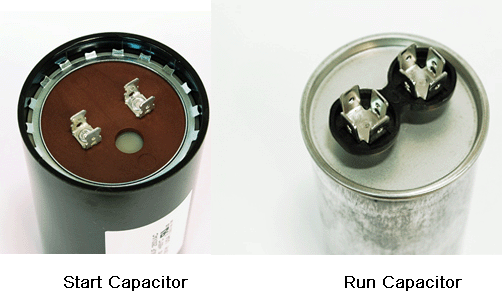
One thing I haven't mentioned is that in electronics there are start caps and run caps. This is important in high powered machines. The start cap provides a voltage jump to get the machine started, and the run cap keeps the machine running. The start cap drops out after a few seconds (45 seconds at the most.) So there are different types of caps.
So what does this have to do with a guitar cap? Well, a guitar pickup (for the most part) is passive. In other words you are not running 220 volts through your pickups, caps and pots. But here's where it gets interesting. A run capacitor is usually oil filled, like a oil in paper cap. In other words those classic caps used in those vintage guitars are run caps.
Even weirder, the poly caps that are used now-a-days are start caps. So I will say there is a difference in what they were originally created to do. Here's a great article about run vs. start caps.
Again, I pride myself on having a dang good ear. I also know my equipment. I've had this guitar for 9 years, and the main testing amp for 10 years. I know in my heart and my ears that changing out the original cap to the Mallory cap didn't change the sound at all.
So, I'm glad I tried. It didn't hurt anything, and I came away with a different point of view. I admit, I have to rethink what I thought I knew about capacitors. I am still conflicted on whether I should spend $5 to test out a paper in oil cap. That's the only thing I can think of that may affect the one that I haven't tried.
Labels:
amp,
bumblebee,
capacitor,
caps,
electronics,
Epiphone,
Guitar,
guitar playing,
Les Paul,
Mallory,
Music,
pickups,
tweek
Location:
Lutz, FL, USA
Subscribe to:
Posts (Atom)