As you know car guys, motorcycle guys, and guitar guys like myself are always trying to "tweek" a little more power out of their equipment. I decided to try an experiment with one of my guitars.
This is not my personal guitar, but looks exactly like my Epiphone Les Paul Honeyburst Plain Top.
There has been a lot of talk on the internet about the different type of capacitors in guitars. Oil in paper caps were in the earliest Gibson guitars, so that's what the gold standard is.
I have read many articles with differing opinions on the subject. Some say if a cap is 0.022 uf., then why change it out for another cap that is the same value, just because it is supposedly a better capacitor? Another article I read ranked the caps from worst to best. The author had a great write-up on how each cap affected the pickups and electronics.
I also read comments where players said it made a difference, and others who said they couldn't hear one lick of difference. Now, I know that not all ears are created equal. I'm not the best player, but thanks to training from my cello teacher Laura, I pride myself on having great ears.
I was always good at recommending pickups to players due to being able to hear the differences in the EQ, compression, and the presence. So if I could "tweek" out a little more tone out of a pickup by just changing a $1 part, I'll give it a try.
The author of the ranked caps article said that he considered Mallory caps to be just second to a true oil in paper cap. I still had a Mallory cap from an old project. (It was my very last cap in my parts drawer.) I decided to use my Epiphone Les Paul plain top as a guinea pig. Here's the Mallory cap.
I sound checked my guitar before changing the cap, and then played it immediately afterward. I only changed the neck tone cap. That way I could focus on one pickup. I also made sure I was taking out a 0.022 cap, and putting in a 0.022 cap.
The result? I couldn't hear one blasted amount of difference. I tried. I really did. I rolled the tone control back and forth. I played through two different amps. I don't think it changed a dang thing.
One thing I will concede is that better made caps are more true to their value. For instance, better made caps have tight tolerances. Meaning if a cap is marked 0.022 uf, then a well made one will be within a 5% or less tolerance. So while one cap may not be better than another type, it could be out of spec. And that could make a difference
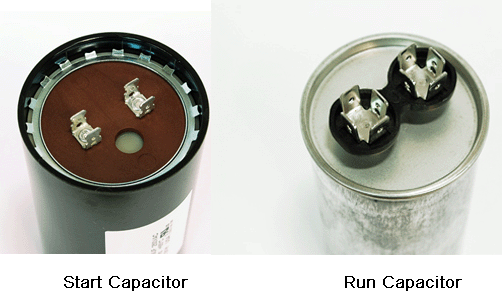
One thing I haven't mentioned is that in electronics there are start caps and run caps. This is important in high powered machines. The start cap provides a voltage jump to get the machine started, and the run cap keeps the machine running. The start cap drops out after a few seconds (45 seconds at the most.) So there are different types of caps.
So what does this have to do with a guitar cap? Well, a guitar pickup (for the most part) is passive. In other words you are not running 220 volts through your pickups, caps and pots. But here's where it gets interesting. A run capacitor is usually oil filled, like a oil in paper cap. In other words those classic caps used in those vintage guitars are run caps.
Even weirder, the poly caps that are used now-a-days are start caps. So I will say there is a difference in what they were originally created to do. Here's a great article about run vs. start caps.
Again, I pride myself on having a dang good ear. I also know my equipment. I've had this guitar for 9 years, and the main testing amp for 10 years. I know in my heart and my ears that changing out the original cap to the Mallory cap didn't change the sound at all.
So, I'm glad I tried. It didn't hurt anything, and I came away with a different point of view. I admit, I have to rethink what I thought I knew about capacitors. I am still conflicted on whether I should spend $5 to test out a paper in oil cap. That's the only thing I can think of that may affect the one that I haven't tried.