Showing posts with label guitar playing. Show all posts

Monday, February 17, 2020

New Guitar Day: Dean Custom 450

I know, I need another "New Guitar Day" like I need a hole in my head.  However, there's a story behind this one.  There's always a story, but this one is pretty good.  You see, it was a dark and stormy night on Facebook Marketplace.  I had noticed an add that simply read, "Guitar" in the Musical Instruments category.

I opened up the ad and saw it was a Dean guitar.  Now for those of you who've read my blog for a while, you know I love Dean guitars.  When I looked at this one I recognized the shape, but couldn't remember the name of it.  So I went to the Dean Guitars official page.  It wasn't listed there.  It seems they don't make it anymore.

After that I went to my trusty friend, "Google."  It was there I found the name of the guitar was the "Custom"  But something didn't look right.  The listed guitar was a set neck with EMG pickups.  The Custom 350 wasn't.  As I wandered around the internet I found out that Dean made a "Custom 450."  That's what this guitar was.

It was exactly as pictured.  It was a set neck with EMG pickups in a natural color.  I think the seller made the same mistake as I did.  He thought this guitar was a Custom 350.  You see, he was selling the guitar for $200.  The Custom 350 sold new for $300.  But the Custom 450 sold new for $600.  Again, they look a lot alike.

When I talked to the seller, he said he bought the Dean to learn to play guitar.  It just didn't happen for him.  So he was moving on.  That's one reason he probably listed the guitar as, "Guitar" on Facebook Marketplace.  He just didn't know the in's and out's of the music industry.

So while I don't need another guitar, I just couldn't let this deal pass me by.  And if I want to sell it later on, I can do that.  Hey, even I realize the resale market isn't great for Dean guitars, but I could possibly make a small profit.

So now let's go onto the photos!


And it came with a leather soft case to boot!  So that added to the deal.


First up, the good.  

All the wood and parts are top notch.  It's really well balanced.  After setting it up, the fretboard doesn't have a wave or twist in it at all.  It's perfect.  Dean likes using the super jumbo frets.  I ended up fret dressing it for two reasons.  The first, is that, I always fret dress my guitars.  Every guitar built needs one, but only high end guitars end up receiving them.  

The second reason is the frets are so dang high it knocks them down a bit for easier playing.  The third is I can set the action extremely low with a great fret job.  

Next up, the gray area.

So Dean factory installed EMG pickups on this model.  That's quite a step up from the usual overseas pickups.  However, players tend to either love or hate EMG pickups.  I've never been crazy about them.  I've always been with the crowd that says, "EMG pickups make all guitars sound the same."  I've found that to be somewhat true except for two guitars.

The first was on an ESP Eclipse 3 that I jammed on in a Sam Ash.  That guitar has an EMG 81 bridge/ 60 neck set.  For some reason it wasn't overly bright like so many I had heard before.  I don't know what made that guitar different?  I had never played that model before, but it was an amazing guitar.  I can see why players like them.

Of all the EMG pickups, I have to say I liked the EMG 85.  It has an EQ that is similar to a Seymour Duncan Distortion.  I'd say the EQ was:  Treble:9, Mids: 8, Bass: 5.  I always thought it should be the main bridge pickup for active pickup equipped guitars.  Instead, they always put it in the neck.

So I immediately decided to so a little pickup swapping.  Since EMG's are quick connect, I just swapped the EMG 81 and EMG 85's positions.  I have to say that was one of the best musical decisions I've made in my life.  The EMG 85 rocks in the bridge position, where the EMG 81 makes a clean neck position pickup.  

Like I said earlier there were only two EMG equipped guitars that I've played that didn't sound overly bright.  This was the second one.  I'm not sure why it sounds so balanced compared with so many other EMG equipped guitars, but this one sounds really good.  

The next upgrade for this guitar, is that, it has 24 frets.  Take a look at the double dots on the last fret.  Yep, that's a 24 fret guitar.


I put this under my "Gray Area" since some players don't need or want 24 frets.  I realize that for some songs you need those two extra frets.  But I realize that a lot of us don't play past the 15th fret.  In fact, a lot of us just play "Cowboy Chords" on the first three.  So again, this would be great for some players, and dismissed by others.  It's really up the individual player.  

The Ugly:

Let's be honest.  This guitar is supposed to compete for metal player crowd.  Specifically, this is Dean's alternative to Ibanez's RG Prestige series.  Here's an example:


So if you ask any metal player what Ibanez guitars are best known for they'll say, "Steve Vai!!!"  But after that they will tell you, "The Ibanez Wizard 2 neck.  For those not in the know, Ibanez has extremely thin necks.  Shredders love thin necks.  They help make playing easier and faster.

So what kind of neck does the Dean Custom 450 have on it?  Well, it's not good.  You start with a Gibson 50's neck, then you make it wider.  By the time you are at the 12th fret, it starts to feel like a seven string guitar.  At the heel this has to be the biggest neck I've ever played in my life.  I know Dean likes big necks.  Heck, I own six Deans and have owned a bunch of others in my life. 

However, this is ridiculous.  The neck up to the first three frets starts off just fine.  It just keeps getting thicker and wider as the neck goes on.  Any player who would put this up against an Ibanez RG is going lean towards the easier playing Wizard 2 neck on the Ibanez.  

The New:

As I mentioned earlier Dean has discontinued the Custom 350, 350-F, 450, and 450-F series.  However, they have replaced it with something that I think will compete with Ibanez a little better.  It's called the Exile series.


The first time I saw the photos I was amazed.  This one comes with the new EMG pickups, the 57 and 66.  It's also built with 24 frets.  However, it also comes with a heck of a price, $1,100.  Whew!  And if you buy the Floyd Rose or seven string models the price only increases.  

It's wonderful guitar.  I only hope they haven't priced themselves out of the market.  I mean, I had a hard decision on paying $200 for the Dean Custom 450.  Paying $1,100 is a big jump up from that.  

But let me get back on track.  I'm digging my new guitar day.  I'm having fun with it.  Now I just have to find a place to put it.  Maybe it's time to build a new wall hanging guitar rack?  Yeah, right after I add a new wall.  Till then, keep rocking, and above all else, have fun with it.

Sunday, January 22, 2017

Squeezing the Tone, Part 2

In a previous blog post I talked about the difference of opinion when it comes to guitar capacitors.  If you have any hope of understanding what I'm talking about here, you may want to read this first.

http://angjellockheart.blogspot.com/2017/01/squeezing-tone.html

So this is what it boils down to.  I have my guinea pig, my Epiphone Les Paul plain top honeyburst.


Now I'm going to change capacitors... again.  This time I bought an oil in paper cap AKA, the supreme mojo thing-a-ma-bob.  The oil in paper cap is supposedly the "bee's knees" of all tone caps. 

As I did say in my previous post, an oil in paper cap is a "run" capacitor.  The polyester caps are "start" capacitors.  I figured there wouldn't be any difference between poly caps, but I had to hear if oil caps really did have that secret, "mojo."

So I put a 0.022 UF oil in paper cap in the bridge tone pot.  I figured that would be where I would hear the most difference. 

I switched out the Mallory 0.022 UF poly cap for a Mallory 0.0153 UF cap for the neck tone pot.  I heard that was the key to getting the ultra super duper secret tone.  Also, it's suggested for the Eric Clapton woman tone.  Correction.  It's one of many suggestions I've read/heard/seen about achieving the woman tone.  So I went for it.


The black one is the oil in paper cap.  The yellow one is the Mallory. 

First up, the Mallory 0.0153 UF cap.


I know it's a little rough, but I've had a few pickups and a few caps in this guitar. 

Next up is the oil in paper 0.022 UF cap.


Once the solder cooled I immediately went for the sound check.  And you know how it sounded?  Exactly like it did before.  I can't say it improved the tone at all.  In all fairness I was already happy with how it sounded. 

I will give it this.  Changing the Mallory cap from 0.022 UF to 0.0153 changed the tone "a smidge" when I rolled back the tone all the way.  But then again, when do I ever do that? 

So, I'm glad I did this little experiment.  But I have to say, it didn't really change my opinion of paying a lot for "higher end" capacitors.  To me, the value is simply the value.  But I will say, I learnt quite a bit.  It answered a few questions I'd had for a while.  So I feel pretty good about that.  Now, off to play a little guitar. 

Sunday, January 1, 2017

Squeezing The Tone

As you know car guys, motorcycle guys, and guitar guys like myself are always trying to "tweek" a little more power out of their equipment. I decided to try an experiment with one of my guitars.

This is not my personal guitar, but looks exactly like my Epiphone Les Paul Honeyburst Plain Top.


There has been a lot of talk on the internet about the different type of capacitors in guitars. Oil in paper caps were in the earliest Gibson guitars, so that's what the gold standard is.


I have read many articles with differing opinions on the subject. Some say if a cap is 0.022 uf., then why change it out for another cap that is the same value, just because it is supposedly a better capacitor? Another article I read ranked the caps from worst to best. The author had a great write-up on how each cap affected the pickups and electronics.

I also read comments where players said it made a difference, and others who said they couldn't hear one lick of difference. Now, I know that not all ears are created equal. I'm not the best player, but thanks to training from my cello teacher Laura, I pride myself on having great ears. 

I was always good at recommending pickups to players due to being able to hear the differences in the EQ, compression, and the presence. So if I could "tweek" out a little more tone out of a pickup by just changing a $1 part, I'll give it a try.

The author of the ranked caps article said that he considered Mallory caps to be just second to a true oil in paper cap. I still had a Mallory cap from an old project. (It was my very last cap in my parts drawer.)  I decided to use my Epiphone Les Paul plain top as a guinea pig.  Here's the Mallory cap.


I sound checked my guitar before changing the cap, and then played it immediately afterward. I only changed the neck tone cap. That way I could focus on one pickup. I also made sure I was taking out a 0.022 cap, and putting in a 0.022 cap.

The result? I couldn't hear one blasted amount of difference. I tried. I really did. I rolled the tone control back and forth. I played through two different amps. I don't think it changed a dang thing.

One thing I will concede is that better made caps are more true to their value.  For instance, better made caps have tight tolerances.  Meaning if a cap is marked 0.022 uf, then a well made one will be within a 5% or less tolerance.  So while one cap may not be better than another type, it could be out of spec.  And that could make a difference

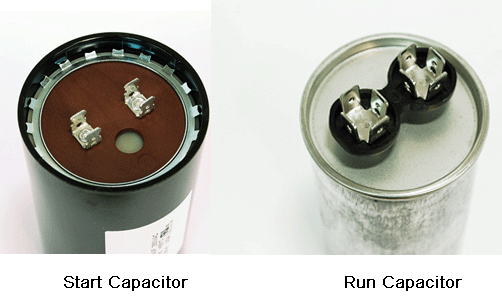
One thing I haven't mentioned is that in electronics there are start caps and run caps.  This is important in high powered machines.  The start cap provides a voltage jump to get the machine started, and the run cap keeps the machine running.  The start cap drops out after a few seconds (45 seconds at the most.)  So there are different types of caps.


So what does this have to do with a guitar cap?  Well, a guitar pickup (for the most part) is passive.  In other words you are not running 220 volts through your pickups, caps and pots.  But here's where it gets interesting.  A run capacitor is usually oil filled, like a oil in paper cap.  In other words those classic caps used in those vintage guitars are run caps.

Even weirder, the poly caps that are used now-a-days are start caps.  So I will say there is a difference in what they were originally created to do.  Here's a great article about run vs. start caps.


Again, I pride myself on having a dang good ear. I also know my equipment. I've had this guitar for 9 years, and the main testing amp for 10 years. I know in my heart and my ears that changing out the original cap to the Mallory cap didn't change the sound at all. 

So, I'm glad I tried. It didn't hurt anything, and I came away with a different point of view.  I admit, I have to rethink what I thought I knew about capacitors.  I am still conflicted on whether I should spend $5 to test out a paper in oil cap.  That's the only thing I can think of that may affect the one that I haven't tried.