Showing posts with label Music. Show all posts

Tuesday, May 12, 2020

New Guitar Pedal Day: TC Electronics Grand Magus: A Review For New Guitarists

I remember the excitement I felt when I bought my first guitar.  Unlike most guitarists who start with a guitar that resembles a piece of gloried plywood, I actually had a pretty good guitar.  I still have it, and it's still a dang good guitar.

But I also remember the first time I walked into Mars Music and tried to buy strings for that guitar.  Before I purchased it, my guitar had been sitting a long time and the strings were beyond dead.  As a cello player I had the experience to know to put new strings on it.  There was no doubt about that.  I could hear how completely lifeless they were.  Not to mention rusty.

So I walk up to the guitar string counter at Mars Music.  There were over 200 types of strings hanging on the wall.  I ask the salesman "What strings do I need to put on this guitar?"

He said, "He didn't know.  They were all good."

I just looked at him, and thought, "Um, isn't this your job?"

For the record my guitar was/is a 1998 Paragon Music Center (PMC) copy of a Joe Pass hollow-body guitar.  It was built in the same factory as the Epiphones at that time.  It's only difference was the headstock design.  It actually came stock with Epiphone pickups.

So I ask the salesman, "Well, I see the sets come in different sizes.  What size do I need?"

He asked if he could check out my guitar.  I said, "Sure."

He replied, "Yeah, those are 10's on there."

"So I guess I should buy some 10's?" I asked.

"Yeah."

"Okay, what brand do you recommend?"

"I dunno."

I started to get a little perturbed.  "I just bought this guitar a few days ago.  I need to put some strings on it.  What should I do?  I don't know jack squat about any of the brands."

So he ended up handing me a pack of GHS 10's.  In some weird way I'm glad he did.  After playing for 20 years I like GHS strings the best.  They have the best bite to them, and they work for my style of playing.

But then a month goes by, and I decide I need a distortion pedal.  Again, I go up to the Mars Music counter, and see hundreds of pedals.  What am I to do?  Where do I start?  This time I asked a different salesman.  Might I say this was also before YouTube and websites that would let you hear what a pedal sounded like before you went to the store.

I tell him what I want, and he says, "Why not try out the DOD Grunge pedal?"  Long story short, I ended up trying it out, and buying it.  I'll say this, it was a good starter pedal.  But also looking back there were much better choices out there.

Now I think of today's new guitarists.  They have ten times the choices that I had!  That goes from guitars, pedals, pickups, amps, picks, cables, mods, etc.  Where does a new guitarist start?  The good news is they have YouTube and guitar forums.  That's a huge help.  I personally have learned a lot about electronics from the internet.

One of the biggest hurdles I had to overcome was music's "marketing language."  You see, a brand can't really say, "This is our take on Marshall's blah, blah, blah."  No, that's trademark infringement.  So companies have these code words they use to describe when their gear has a similar sound to another companies' product.

It goes like this:

American Rock Sound = Fender.
British Rock Sound = Marshall.
California Sound = Mesa Boogie.

When they can't say "Les Paul" or "Les Paul style" guitar, they say, "LP" or "Single Cutaway."
When they can't say "Stratocaster" they say, "Double Cutaway."

If you read study enough and look around the internet you'll start to pick up the lingo.  And why is that important?  Because like I said earlier, todays' musician has more choices than ever before.

When I started the very first distortion pedal everyone usually bought was the Boss DS-1 Distortion.

It's a simple circuit and has been used by many famous guitarists despite being a relatively cheap pedal.  For years you could buy one new for $39.99.  Heck, Kurt Cobain used this pedal on a lot of Nirvana's songs, especially on the their first release "Bleach."  

Today, the pedal market is at an all time high for the sheer number of pedals on the market.  You have the brands that have been there for a while, "Boss, Digitech, and Electro Harmonix."  You have also more custom builders now than there ever has been.  And then you have everyone at every price point in-between.  

Lately TC Electronics has been making some great pedals at a dang good price point.  During a holiday sale two years ago they had a special going at Guitar Center.  Three pedals for $99.  You have to remember back when I bought that DOD Grunge pedal, it cost $54.99 in 1998.  

With inflation think of what that pedal would cost today.  The CPI Inflation Calculator says that would be $87.85 in today's money.  And those were the cheap pedals!  So this leads to the question, "Well, how good can TC Electronics' pedals be if they are that inexpensive?"

To be honest, I have found them shockingly good.  I love their Choka Tremolo pedal.  The Nether Octave is a great octave for it's price point.  The El Mocambo is one of the best Tubescreamer clones I have heard.  I'll say it this way, it works for me.  It may not be for everyone, but it works for me.  

So when I saw that TC Electronic had a pedal called the Grand Magus I was immediately interested.


What surprised me was how many I found on the used market. Unlike a lot of TC Electronics' products this one didn't have as many good reviews.  I listened to a few clips of it on the internet, and was really on the fence about it.  It sold new for $50, and used for $25 plus shipping.  

I ended up pulling the trigger on one, and couldn't wait to plug it in when it arrived.  I immediately loved it.  So what changed my mind?  There are quite a few reasons.  Let me start at the beginning. 

One of the best pieces of advice I can give any beginning metal guitarists, is that, there are two main ways of EQing your amp.  I'm going to keep it overly simple because again, I want to speak to a beginner.  First up is what I'll call, "The Metallica way."  On your EQ knobs you turn up your treble and bass, and turn down or (scoop) the mids.  Dimebag Darrell's signature sound was also like this.

Next up, we have what I'll call, "The Slayer way."  Think of Slayer's song, "Seasons in the Abyss."  That first really heavy cord you hear?  That's mids baby.  Slayer uses what they call the "frowny face" EQ.  They turn town the bass and treble and crank up the mids.  

So the "overly simple" explanation is there are two main EQ's when playing metal.  #1. Scooped mids, or #2. Lots of mids.  Players tend to be in one camp or or the other with no in-between.  The scooped sound is all the rage, but your bass can be lost when playing with an actual bass player.  I'm in the camp that says, "Mids are where the angry lives."

Marshall's sound is known for their full midrange sound.  This is due to their use of EL-34 tubes.  The Grand Magus pedal has a lot of mids.  When you go to the Grand Magus webpage they use every bit of musician lingo to try to let you know this is a Marshall type of sound.


There are a few reasons I didn't care for the reviews online.  First, recording and making mids sound right is tough.  It tends to come through as buzzy.  Then, when that same clip is played through computer speakers it sounds even worse.  

The other reason I didn't care for the reviews online is for something you wouldn't think of.  The tone control on the Grand Magus pedal is extremely wide.  It's so wide you can get a bad sound out of it.  Think of it this way.  The doom/stoner metal crowd is a big fan of Orange amps.  To me they always sounded muddy with no harmonics, but to each their own.  

Well, the tone control on the Grand Magus is so wide that you can get into that doom/stoner metal territory.  But if you turn the tone control up, you can get that classic Marshall sound.  I also want to give TC Electronic props for having the gain control have such a wide distortion.  You can use this pedal for slight blues breakup to full blown Marshall stack.  One thing you'll learn is a lot of pedals' gain knob maxes out of 12 O'clock.  The Grand Magus makes full use of the gain control.  

I realize I may get a lot of hack on this post.  I'm sure a lot of more experienced musicians will say, "So you think a $25 pedal is good?"  I'm saying I wish when I started it was the first pedal I bought.  It would have been a lot more useful to me than the DOD Grunge.  

And for the record, my "good" pedal is a Hughes and Kettner Tube Factor pedal.  


But I'm not going to tell a new player they should buy a $279 pedal right out of the starting gate.  I'm saying if a new player wants that mid heavy Marshall sound at a decent price, buy a used TC Electronic Grand Magus.  It will be a great decision.  Also if they hate it, they can get their money back on it by selling on Craigslist.  

So to my beginner guitar players.  You have many choices out there.  Remember this.  You vote with your dollars.  That goes for anything in life.  My small amount of advice to you is this.  If I was the salesman at Mars Music, and I had a first time pedal buyer asking me about the first pedal I should buy, it would be the TC Electronic Grand Magus.  (Note: Yes, I realize they didn't exist back in 1998.)  

For those players who say, "No man!  I want that mid-scooped sound!"  Well, you can always buy a Biyang Tonefancier Metal End King.  That will sure scoop the hell out of your mids.


Wednesday, May 6, 2020

New Guitar Day: Slapa Da' Bass Edition

About a month ago I had a longtime friend of mine decide to clear out some of his old basses.  He's a touring musician, and has collected quite a few instruments.  He told me that he's made a lot of friends across the country, and would pick up instruments at great deals.  But all those great deals were taking up space in the house, so a few had to go.

He posted a photo of a Squier Classic Vibe 60's Jazz Bass, and said he was happy to let it go for $100.  I immediately said, "That's an awesome price.  Someone will snatch that up for sure!"  I would have bought it, but I already had a Dean Juggernaut bass.  That's their version of the Fender Jazz Bass.

But then I got to thinking.  I remembered when the Classic Vibe Jazz Bass series came out.  It was everything I wanted in a bass.  The Olympic white with red tortoiseshell pickguard was the exact color scheme I love in a Fender type guitar/bass.  I also really liked the fact that the neck was a golden vintage tint with a rosewood fretboard.

After about two weeks I messaged my friend, and asked him, "Say, has anyone bought that bass from you yet?"  Shockingly, he said, "No."  When those basses were new they cost $400 plus tax.  $100 was a steal.  So I told him, "I had to have it!  When can I drop by?"

So I dropped in the next day, and handed over the cash.  I wish we could have talked more, but with the Covid-19 craziness happening we had to keep it short.  But it was good to see him, even if for a short time.

I immediately loved the bass.  The set-up was different than how I set up a guitar or bass, but somebody really took the time to make it easily playable.  What has shocked me the most on the entire Squier Classic Vibe series are the pickups.  They have installed some extremely awesome pickups for a guitar or bass at that price point.

Before I go into my tinkering I'll post some photos of her.


I have to say someone had performed a wonder fret-dress on this bass.  It was smooth.  Again, everyone has preferences on how they like their instrument set up.  With this bass I decided to shim under the neck.  This way it would lower the strings from the fifth fret up.


I know I said I loved the pickups, but I still had to tinker with them.  A few weird coincidences happened.  I had a Jerry Sentell Jazz Bass bladed bridge pickup that was going to go into another build.  That build never happened so I've had it laying around for a while.

I also managed to snag a used Seymour Duncan Vintage Jazz Bass neck pickup for a good price.  So I installed both pickups into this bass.  I also used some really thick and strong foam to push the pickups up closer to the strings.  I also changed the strings to my usual GHS Boomers.  I also prefer to install Fleor strap-locks, so I did that as well.


All in all it didn't require too much work on my part.  I cleaned it up a bit with my favorite Ken Smith polish.  I also used a large paintbrush to knock some of the dust away from the bridge saddles, but after that I could call it a day.

I gotta say I'm having fun with it.  I don't play bass that often so it takes me a while to get back into the groove when I pick one up.  Now I just have to find a place to keep it.  Like my friend I'm starting to run out of room here.  Oh well.  Such is the life of musicians.

Tuesday, March 31, 2020

Chasing Tone: 50's Guitar Wiring

As you know, I, like many other musicians, are always on a quest for tone.  I've written many posts on this blog about the subject.  Whether it is guitars, pickups, electronics, or capacitors, I am always on the hunt for a way to achieve the perfect. tone.

I came across an article a few weeks ago that was talking about a surprisingly easy and inexpensive way to improve the tone of a guitar.  Here's the link:

Mod Garage: Three Ways to Wire a Tone Pot

The author brought up a good point.  We look to the 1950's Gibson PAF pickups as the "Holy Grail" of all pickups.  But in all honesty, pickup makers today can create pickups that are just as good, if not better than those vintage PAF pickups.  So what's the difference?

As I've written before, many players are extremely fickle about their tone capacitors.  Some claim they can hear the differences between cheap ceramic caps and paper in oil caps.  Here are a few blog posts I wrote about trying out different caps.

Squeezing The Tone

Squeezing the Tone, Part 2 

Long story short, changing the capacitors did nothing for me.  For the heck of it I bought an old Russian paper in oil cap, and soldered it into my Dean Dixie Rebel.  Honestly, I couldn't hear a bit of difference.  That cap cost me $5, and that's on the cheap side.  The modern day Emerson paper in oil caps cost $20 a piece.  Let's be honest, $20 is way over the top for a capacitor.

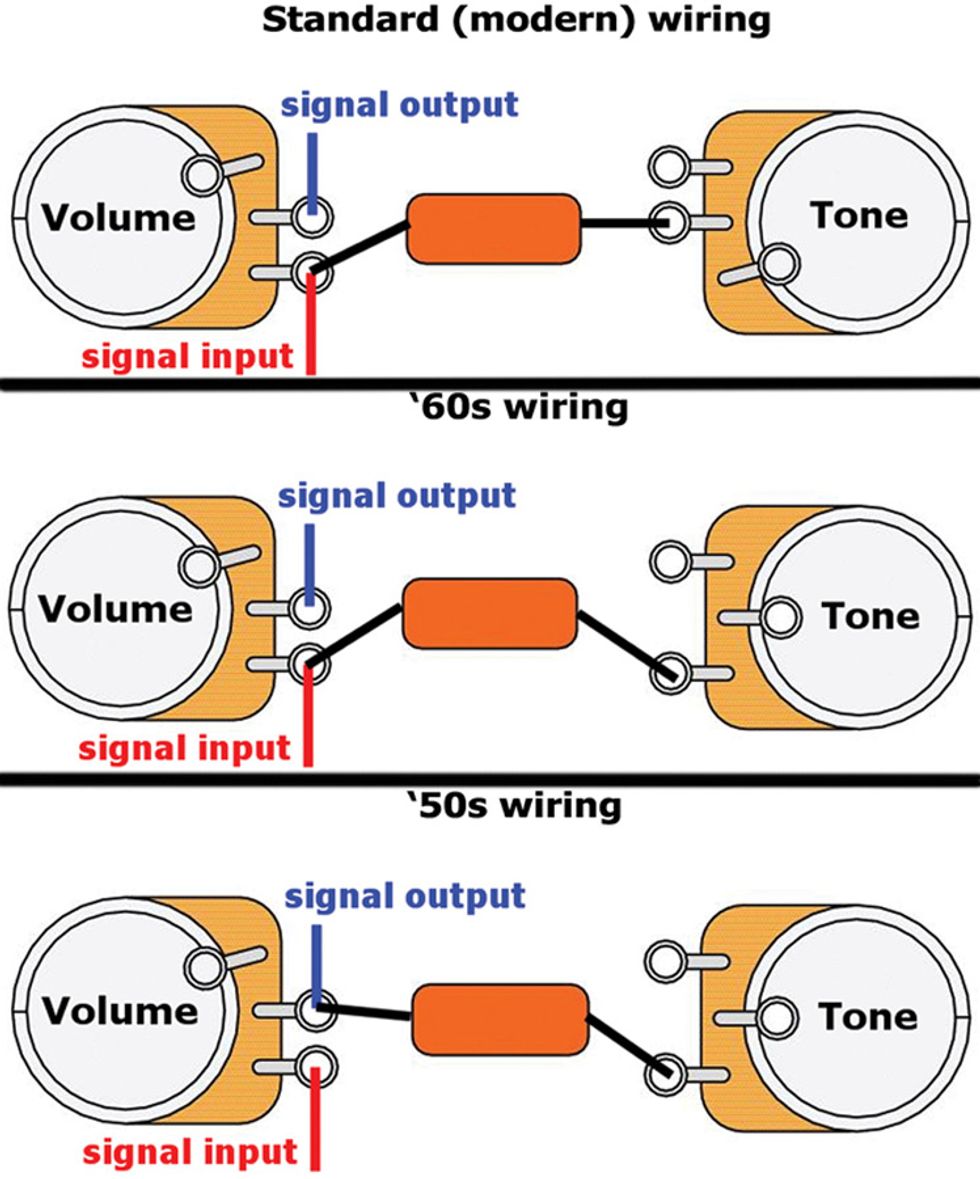
So when I read the article posted above I originally took it with a grain of salt.  But the author said something that I hadn't thought of.  We accept those PAF pickups as the "Holy Grail" of pickups, but we are forgetting one thing.  They were also wired with 50's wiring.

Now I know you are wondering, "What does that have to do with anything?"  Well take a peek here.


From the article:

The tone cap connects to the volume pot’s output lug, rather than its input.

What’s so special about the ’50s wiring? It will influence the guitar’s performance in three major ways:

1. The overall tone gets stronger and more transparent. It’s difficult to describe, but I think of it as more “in your face.”

2. The typical treble loss that occurs when rolling back the volume is greatly reduced, and both the volume and tone controls react more smoothly and evenly without the typical hot spots. As a side effect, it’s easier to clean up an overdriven amp by simply rolling back the volume on your guitar a bit.

3. The tone and volume controls interact with each other—something you may know from certain early Fender tube amps. When you change the volume, the tone also changes a little bit and vice versa. Such interaction may feel strange at first, but it only takes a few minutes to get used to.

I've cut out a lot of the technical jargon, so I'll boil it down here.  The main problem with modern wiring is when you roll back the volume or the tone knobs.  Simply put, it doesn't sound great.  When backing off the tone knob, the biggest problem is the loss of volume in the high/treble sounds.  

So I decided to use my Guild Bluesbird as a guinea pig for this project.  I've written about it before.  Here's the link:


In that blog post I showed a few mods that I had made to "squeeze the tone" out of it.  Namely, I replaced the Alnico 5 magnet in the 59 neck pickup to an Alnico 2.  I also changed the cheap ceramic caps out for "Tropical Fish Capacitors."  (Yes, that really is what they are called.)

So here is the guitar we are working with.


And here is the inside control cavity. 


Let's fast forward to changing the wiring.


Honestly, it wasn't that hard or time consuming.  But here's the question... did it deliver promised results?  I mean, I've heard a lot of rumors, inuendo, and B.S., but did this actually work?  

Yes.  Yes it did.  I noticed a huge difference.  The sound really was more, "In your face" as described by the article.  Where I really noticed it was turning down the tone pots.  The high/treble sound didn't drop out like it had done before.  In other words, there was no loss of volume of the high/treble notes. 

I also noticed the pickups sounded much brighter.  The 59' neck pickup (with an Alnico 2 magnet) sounded extremely balanced.  They might be considered too muddy for high gain/metal players.  But with 50's wiring it sounded amazingly balanced and soulful.  

The 59' bridge pickup (stock) was much brighter.  It actually reminded me of 1950's music.  I know all the advertisements like to say their vintage pickups are warm, blah, blah, blah, etc.  Have you ever listened to late 50's/early 60's music?  Think of the Beach Boys.  Listen to them and realize how bright their sound is.  I know they are playing Fender instruments, but still, the 50's sound was pretty bright.

With 50's wiring the Seymour Duncan 59' sounds exactly like it rolled off the line at Gibson back then.  What also surprised me was that the bridge pickup had quite a bit of bite that it never had before.  I think some folks might mistake it for a Seymour Duncan Pearly Gates pickup due to the amount of bite it had.  

The verdict?  The verdict is yes.  In fact, it's a huge yes!  In complete honesty I didn't think it would make that much of a difference.  And the one thing I hadn't thought of was, "How do different types of capacitors react with 50's wiring?"  Those paper in oil caps might make a bit of a difference with 50's wiring.  

I already had quality Tropical Fish Capacitors installed in the Bluesbird.  So I'm not sure how much (or little) of an upgrade they are over cheap ceramic caps.  But to get back to the point, 50's wiring really did make that much of a difference.  I'm going to be doctoring a few of my guitars in the coming weeks.  

I am thankful for Premier Guitar for running the wiring article.  I am reminded of what a violin luthier told me.  He said, "We can make anything as good as Stradivarius these days due to sharing so much information.  We don't have to keep reinventing the wheel every ten years."  

So I have written this blog post to keep sharing information.  I believe it's important.  I've seen the quality of guitars skyrocket in the last twenty years.  I've seen the parts on those guitars skyrocket as well.  Sharing information is pivital to making amazing music.  I hope I've helped you out some.  

Sunday, October 27, 2019

New Pedal Day: Tinkering With A Mouse So It Becomes A Rat!

I have written a number of blog posts about my favorite guitar pedal company Biyang.  They are a family company located in China that builds high quality guitar pedals for much less than other brands.

For those who don't know, Biyang also ghost-builds guitar pedals for other companies.  All the Guitar Fetish pedals?  Yep, those are built by Biyang.  The high end Akai pedals that go for $150?  Those are just rebranded Biyang pedals.  They have the exact same components and wiring that the original Biyang pedals do.  Only the Akai pedals cost three times as much.

Biyang also makes pedals for Cordovox.  In fact, they don't even change the look or model names for them.  They just put Cordovox instead of Biyang on the pedal.  So you can see my point, in that, Biyang is a dang good company, and you might be playing one of their pedals and not know it.

For the last year I had been reading up on the Rat Pro Co pedal.  It's famous for that 80's metal sound.  But it has many uses.  I mean, Blur's well known song, "Song 2" is a perfect example of the Rat Pro Co.  So it's not like the Rat is only designed for hair metal.

Biyang is known for using specs of other manufacturer's pedals, building with high end German parts, and coming out with a clone version of those pedals.  I was really interested in their version of the Rat.  Well, lo and behold, they have the "Biyang Mouse DS-8."

 
Unfortunately, unlike a lot of their other pedals, I hadn't heard good things about this one.  I guess it was so poorly liked, they took it off the market.  This made things a bit rough for me since I couldn't find one available in the states.  But then, I got to thinking.  Remember what I said about them building pedals for other manufactures?

Biyang made two versions of their pedals for themselves.  The Tonefancier series was encased in a chrome housing.  They would then make a second, more colorful version of that pedal.  So I started looking around.

I found a new-oldstock Biyang Distortion pedal on Reverb.com.  I thought to myself, "That's got to be the same pedal as the "Mouse."  I read up on the description, and it was the same as the Mouse.  So I pulled the trigger, and bought one.

But I also had a plan.  You see, in my research I came across a guitar forum user named "11 Gauge."  Note: That refers to a wire size, not a shotgun.  He talked about the Mouse, and how it was virtually the same as a Rat except for one thing.  They had installed a 56K ohm resistor where they should have installed a 560 ohm resistor.  Here's his photo:


So when my Biyang Distortion pedal arrived I tested I immediately tested it out.  I had to agree with the reviews.  It just wasn't that great sounding.


So I took it apart, and checked the circuit.  Guess what?  It was exactly the same as the Mouse.  Exactly.  Also, it had the same flaw as the Mouse.  It had that stupid 56K ohm resistor instead of a 560 ohm resistor.


Long story short, I bought a pack of 10 resistors so I could use one.  I took my sweet time, and changed out the incorrect resistor as per 11 Gauge's instructions.


I tested it out on the bench, and I have to say I noticed a few things.  First up, it had a lot more usable gain.  You could get that super crunchy gain if you wanted, but you could also get a slight breakup if that was the sound you were after.  The other thing I noticed was the three way switch was more effective.

It has three modes: (from top to bottom) Normal, Bright, Warm.  I always kept it on Bright.  The other two settings just cut the volume.  I didn't really notice any difference in sound on Normal or Warm.  Once I changed the resistor I did notice a bit of difference to the sound.  It still dropped the volume, but it wasn't as bad as it was.

I'll be honest, if I knew more about electronics I would just take the three way switch out.  I don't think it adds anything.  Honestly, I think it takes away more than it gives.  But that's just my thoughts.
I haven't had a chance to play around with it as much as I would like, but I was happy with the sound when I did play it.  I'm looking forward to hearing how it sounds with single coils, vintage humbuckers, hot pickups, and active pickups.  Again, like I tell other players, "Just have fun with it."  And that's what I'm going to do.  I'm going to have fun with it.

New Guitar Day: Agile Interceptor 725, My First Seven String Guitar

So it finally happened.  For those who know me, know I started my musical life in 1988.  That's when I picked up and learned to play the cello.  In 1998, I bought my first guitar, and started playing it.  But now, in the year 2019, I bought my first seven string guitar.

I had been wanting one for a while.  I mean, I don't play Korn or anything that would require a seven string, but I had been wanting one just so I could scratch that musical itch.  One thing that kept me from purchasing a seven string was the cost and availability.  There's just not that many manufacturers that make seven strings.  So the decently made seven string guitars on the market are a bit pricy.

The other thing I kept running into was that a lot of them had Floyd Rose tremolos.  And honestly, I didn't want to deal with that if I didn't have to.  Also, a lot of seven string guitars tend to be really pointy and 80's looking.  I wanted to avoid that as well.  So it's good that I know what I want, but I've really painted myself in a corner with what I want.

I was searching on Facebook Marketplace when I saw a seller offering an Agile 725 Interceptor seven string guitar.  We agreed to meet at Guitar Center so I could test it out.  Long story short, I was more than happy with it and bought it from him.  Here's the photos:


The 725 model refers to a 25.5 inch scale length.  The 727 model refers to a 27.5 inch scale length.  I know a lot of players would prefer the longer scale length, but I found the shorter/standard length to be just fine.

There were a few nice upgrades on this guitar when I bought it.  First up, someone had installed the Seymour Duncan AHB-3 Blackouts active pickup set.  The fret numbers are actually aftermarket stickers attached to the fretboard.

I personally love the blue/green color.  It's not a standard death metal color.  Remember when I talked about painting myself into a tiny little corner with what I wanted?  Well, this color is the perfect color for me.


I also changed the knobs to a green abalone set that I had sitting in my drawer for a few years.


They are a perfect match for this guitar.  Although technically, the chrome should be black to match the black hardware, but I'm not sweating it.

The guitar did need a set-up, but overall it was about 95% the way there.  The truss rod had never been set.  I only had to turn it a very small amount for it to be perfect.  I also moved the pickups closer to the strings.  It's very important to do that with active pickups.  Here's how I did that with direct mount pickups.

As you can see, the pickups are not as close as they should be to the strings.


So I took some foam padding, cut it into shape, and put it underneath the pickups.


Now let's take a look.


Yeah, that's much better.

I was aiming to fret-dress the guitar, but all notes are nicely playable.  Even with the strings being really close to the frets.  Heck, I haven't even changed the strings yet.  I have to say I love the sound.  Once I played it for the first time I just felt something come over me.  I immediately had to play angry music.  It feels like a new musical door opened for me.  I'm going to have to see what's through that door.

For those who are interested in Agile Guitars they can be ordered directly from the manufacturer.  Here's the link:

https://www.rondomusic.com/

Sunday, May 5, 2019

Tattooing Josh's Guitar

I have this friend named Josh.  Josh is a great guy, but he's a little rough on his guitars.  In fact, I've written three blog posts previously about how rough he is on his guitars.  Here they are in order.

Repairing Josh's Guitar, Part 1.

Repairing Josh's Guitar, Part 2 

Repairing Josh's Guitar.... Yet Again 

So after roughing up his Dean acoustic Josh decided to buy one of the newer Martin Guitars that are made in Mexico.  The interesting thing about these guitars, is that, they have a thin, almost hand rubbed finish on them.  It helps in projecting sound, but it so makes them vulnerable to be dinged up.

As I was setting up the Martin, Josh told me how he had all his students sign his guitar.  He wanted me to do so as well.  As I looked over the back and sides there must have been fifty signatures all over it.  So I added my signature as well.

I told Josh if he was writing all over his guitar I could do some wood-burning on the top of it.  I showed him the different tips I had for wood-burning, and what designs I could do.  He agreed to it, but only wanted a few designs.  So this is what we came up with.


I kept trying to add more to the designs, but Josh wanted to keep it minimalist.  A few weeks later I sent him a photo.  It's test piece to show Josh what I could wood-burn into his guitar.  This is the photo I sent him.


He then changed his mind, and said I could burn whatever I wanted into the guitar.  So yesterday I came up with this.


And here it is after being strung up.


The writing underneath the fretboard says, "Linda's Voice."  Linda is Josh's Grandmother.  He named this guitar after his Grandmother, so I suggested we wood-burn her name into the guitar.  I also thought that maybe we should add either "Song" or "Voice" after her name.  Josh thought that was a great idea, and chose "Voice."

So there's still room to add more "tattoos" later on.  I was thinking about something like the tree of life designs that some Ibanez Guitars have on their fretboards.  Except I would have it start at the bottom end of the guitar, and come around past the bridge, and underneath the soundhole.  It's something to think about down the road.  But for now I think it's perfect.

Saturday, April 27, 2019

Cajon! I'm A Drum Guy Now

It was while I was playing music at coffee shops that I discovered a percussion instrument that I didn't know about.  It's called a Cajon (pronounced Caw-Hone.)  What made it neat was that you could achieve the sounds of a drum, but at a lower volume.  This is very important for coffee houses where a lot musicians play acoustically, and don't want to be blown out by a complete drum set.  It's also hand held so it can be carried quickly and easily.    

What surprised me was just how versatile they are.  Depending up technique, strength, and spot, striking the Cajon can give you a number of different sounds.  So I finally decided to buy one.  I can't purchase a full sized drum set, but I can make space for a Cajon.  

I had checked out a few models at Guitar Center.  There was one in particular that I liked.  However, I happened to be across the street from Sam Ash Music, so I thought I would stop in and see their selection.  I tried out nine different models of Cajons, but kept coming back to one in particular.  That one happened to be the last of that model, and was on closeout.  

After inspecting it I found out why.  It had: 1.  A chip in it.  2.  Was a bit scratched up.  3.  Missing a screw.  4.  Missing a rubber foot.  Now, this may have bothered some people, but it didn't bother me.  I can always insert a screw.  I can always replace the rubber foot.  I was always going to bang it up.  It's a drum after all.  So those things didn't bother me. 

The MSRP was $240, but we all know that means nothing.  They normally sold for $140, but this one was on closeout for $99.  So I bought it.  They had Cajons priced higher and lower than this model, but this one just had "my sound."  

And here she is:


However, I didn't want a Cajon that looked just like everyone else's.  I wanted something that stood out.  So I took my wood-burning tools to it, and now she looks like this:


Not bad, eh?  I'm really proud of that.  This from a guy who couldn't draw worth a crap his whole life.  Admittedly, I did use measuring sticks and straight-edges to make sure everything was even.  

So when I showed my Cajon to my family they were like, "What's with the box?"  That's when I hit it a few times and their hands went over their ears, and they started screaming.  Okay, I don't actually play that bad, I'm just loud.  That's when they discovered the power of the Cajon.  

My sister told me if I bought another Cajon I would have two of them.  I could then refer to them as "my Cojones."  That's a Spanish joke if you don't get the reference.  I'll admit, that was pretty funny.  

So I'm going to continue to "tattoo" my Cajon.  Little by little, as I am inspired with new ideas I will wood-burn into it.  Luckily, it has six sides so I have plenty of room to wood-burn.  But now I have to actually spend more time playing it than I do wood-burning into it.  I'm not sure how that's going to go down around here?  But you know me.  I'm going to have fun playing it.  That's what music is all about.  

Wednesday, January 16, 2019

Pills

I have really been digging this Americana and Alt/Country sound that has been coming up this last decade.  What I'm really glad to see is so many female artists being given the chance to be heard.  One such artist who I really dig is Sunny Sweeney.  Her album, "Trophy" is great.  It's all killer, no filler.


The standout track on the album is a song called, "Pills."  It was played on both our local station 88.5 WMNF and Sirius XM's Outlaw Country.  


Another great artist I follow is Sarah Borges and the Broken Singles.  I just bought her new album, "Love's Middle Name."  


As I was looking over her new album I noticed track number five.  "Are You Still Taking Those Pills?"  I thought, "It couldn't be the same song, could it?  Not so close to Sunny Sweeney's release?"  So I popped the CD in (yes, I still buy CD's,) and what do you know?  It was the same song, just performed in a different style.


So I started looking over the info on the CD.  It gave writing credits for the song to, "Brennen Leigh and Noel McKay."  So I had to look them up on YouTube.  And guess what I found?


It seems this little song has been getting around these last few years.  I suspect that it is going to be rerecorded a few more times.  It has "hit" written all over it.  I really hope someone can break through with it.  

Friday, December 28, 2018

New Guitar Day: Agile 2500: Not Impressed

It finally happened.  I had a bad "New Guitar Day."  It was bound to happen sometime in my lifetime.  But some of this is on me.  Let me start at the beginning.

As I was looking over the Rondo Music website, home of Agile Guitars, I saw a B-Stock guitar that was exactly what I was looking for.  It was a Les Paul style guitar with P-90's.  I didn't want the P-90's so much as I wanted the P-90 route.  I was going to put mini-humbuckers in it.

It's easier to find a Les Paul style guitar with P-90's than mini-humbuckers.  Since I was going to change pickups anyway, even if it had mini-humbuckers, I looked for the best deal I could find.  Unfortunately, that came to bite me in the butt.

So this blue flamed, Les Paul styled guitar was actually marked down quite a bit in price.  It was considered B-Stock due to some damage on the fingerboard.  I thought, "Well, that's nothing.  I'm sure to accidentally bang it around in the first week.  It's going to have more dings than that in a short time."


So I bought it at a greatly discounted price due to the damage and finish imperfections.  When I received the guitar I had so much going on I didn't actually play it.  I took it out of the box, and put it on my workbench.  I then went out of town for a few days.  So I had it for a bit before even getting to mess around with it.

Once I played it I noticed the action was insanely high.  I thought, "Well, it probably just came from South Korea, and no one has even looked at it.  No matter."  But matter it did.  Usually when I start work on a guitar I do everything at once.  This was no different.

I started with a fret dress.  I then removed the P-90 pickups.  I realized to fit the mini-humbuckers I would have to do a few modifications.  Namely, I needed to cut holes in the route so that the pickup feet would fit.

Here is what it looked like after I cut the holes for the feet:


I also had to drill holes for the mini-humbucker pickup rings.  (Note: not pictured.)  That took a bit of time and effort as the rings just barely covered the hole.

After a lot of back and forth I managed to get the mini-humbuckers installed, I started to set the guitar up.  That's when I noticed I was having problems with frets, 14, 15, and 16.  I still had dead spots.

I couldn't figure out why that would be.  That is, until I looked down the neck.  It was then I discovered that where the neck met the body, the heel was kicked up.  I was instantly furious.  Not just at myself, but at Rondo Music for letting that guitar out of the factory.

For those who know me, know I worked as the repair department for Dean Guitars.  At Dean we never would have let a guitar like that be sold, even as B-Stock.  It should have been marked at X-Stock, stripped of it's parts, and the body destroyed.

I wrote Rondo Music since they don't have a publicly listed phone number.  I told them I had modified the guitar, but since it shouldn't have been sold in the first place, could I return it?  Frankly, I received a lot of attitude in the message back.

I wrote explaining that I was, in fact, a luthier who actually went to luthiery school, and apprenticed under a master luthier.  I told them that guitar should have never left the factory.  I'll admit, I told him that when I received the guitar, the strings were so high you could shoot arrows off of it.  Of course, they had the action that high so it would make the 14th, 15th, and 16th frets playable.

What I received back was an E-mail critical of my skills.  It also stated that they dealt with 50,000 guitars, and knew what they were doing.  Also, if I had bought a Ford or Chevy, modified it, and tried to return it, would the dealer accept that return?  He didn't think so.  But he finished the e-mail saying, just return it, and they would see what they could do.  He wasn't promising anything.

I'll admit, I was pretty hostile.  The e-mail was written in a very nasty tone.  So I went to work on the guitar.  I took the mini-humbuckers out, and reinstalled the P-90's.  It was then a thought occurred to me.  If I sent it back, they would just try to set it up and then send it back to me.  Well, since they did such a shitty job the first time, why would I trust them to do it a second?

So I set the guitar up to where it would be playable.  That way, if they said, "Nothing was wrong with it," I would know they didn't even try.  That, or they have some really lazy and incompetent people working there.  So I set it up.

I raised the action on the high E (treble) side.  I had both sides at 2/32nd's.  That basically what I set a Floyd Rose equipped guitar to.  That way, players can dive bomb or pull back as far as possible and it won't fret out.  Would you know that just raising it that much cleared it enough so that all notes were playable?  Again, I was furious at myself for not trying that earlier.  I just got into too much of a hurry.

So now I had a dilemma.  If I sent the guitar back, they would look at it, play it, and say there's nothing wrong with it except for the holes I drilled in it.  They would then just send it back to me leaving me in the same place I was before.

So after consulting a friend I decided that I wouldn't return it.  When it comes down to it I modified the guitar.  After fret-dressing and setting the guitar up correctly there was nothing Rondo Music could do with it.  I doubt I was going to get a refund, so why bother trying to return it?


So I wrote a very straight-forward e-mail saying, "After continuing work on it, I made the guitar playable.  Since I had modified the guitar I understand I couldn't return the guitar for a refund."  I left it at that.  I also received a very simple return message that said, "Thanks for the update."

Now, I understand I should have looked the guitar over before I started work on it.  I'm just so used to performing all my work at once.  I've found there's not much I can't do, but I'm used to working on guitars that would pass a basic inspection.

What upsets me is the way the e-mails were worded.  They came across as pretty nasty.  I mean, I'm actually a returning customer.  That's right.  I bought an Agile guitar four years ago.  I wrote a blog about it.  Here it is:

New Guitar Day: Christmas Edition


So it's not like I've never dealt with Rondo Music before.  I like my Root Beer colored Agile.  I thought it was a better quality guitar than any of the comparable South Korean made Epiphone Les Paul's.  But this blue 2500 fell far from the tree.

And the lousy thing is I put the P-90's back in it.  I have been working myself back up to putting the mini-humbuckers back in it, but I just haven't had the motivation.  In fact, I forgot to take photos of the guitar with the mini-humbuckers in it, hence, why none are posted on this blog.

Eventually I will get around to installing the mini-humbuckers.  After I do that I'll post a blog reviewing them.  The pickups I bought were a set of Alnico 2 mini-humbuckers by Artec.

Again, what upsets me about this guitar is the way I was treated, and that Rondo Music would let a guitar like that leave their factory.  I have it playing alright, but it should be so much better.  I'm also hoping that the kick up at the heel doesn't get worse with time.  Right now, I'm not sure I will ever buy from Rondo Music again.