I came across an article a few weeks ago that was talking about a surprisingly easy and inexpensive way to improve the tone of a guitar. Here's the link:
Mod Garage: Three Ways to Wire a Tone Pot
The author brought up a good point. We look to the 1950's Gibson PAF pickups as the "Holy Grail" of all pickups. But in all honesty, pickup makers today can create pickups that are just as good, if not better than those vintage PAF pickups. So what's the difference?
As I've written before, many players are extremely fickle about their tone capacitors. Some claim they can hear the differences between cheap ceramic caps and paper in oil caps. Here are a few blog posts I wrote about trying out different caps.
Squeezing The Tone
Squeezing the Tone, Part 2
Long story short, changing the capacitors did nothing for me. For the heck of it I bought an old Russian paper in oil cap, and soldered it into my Dean Dixie Rebel. Honestly, I couldn't hear a bit of difference. That cap cost me $5, and that's on the cheap side. The modern day Emerson paper in oil caps cost $20 a piece. Let's be honest, $20 is way over the top for a capacitor.
So when I read the article posted above I originally took it with a grain of salt. But the author said something that I hadn't thought of. We accept those PAF pickups as the "Holy Grail" of pickups, but we are forgetting one thing. They were also wired with 50's wiring.
Now I know you are wondering, "What does that have to do with anything?" Well take a peek here.
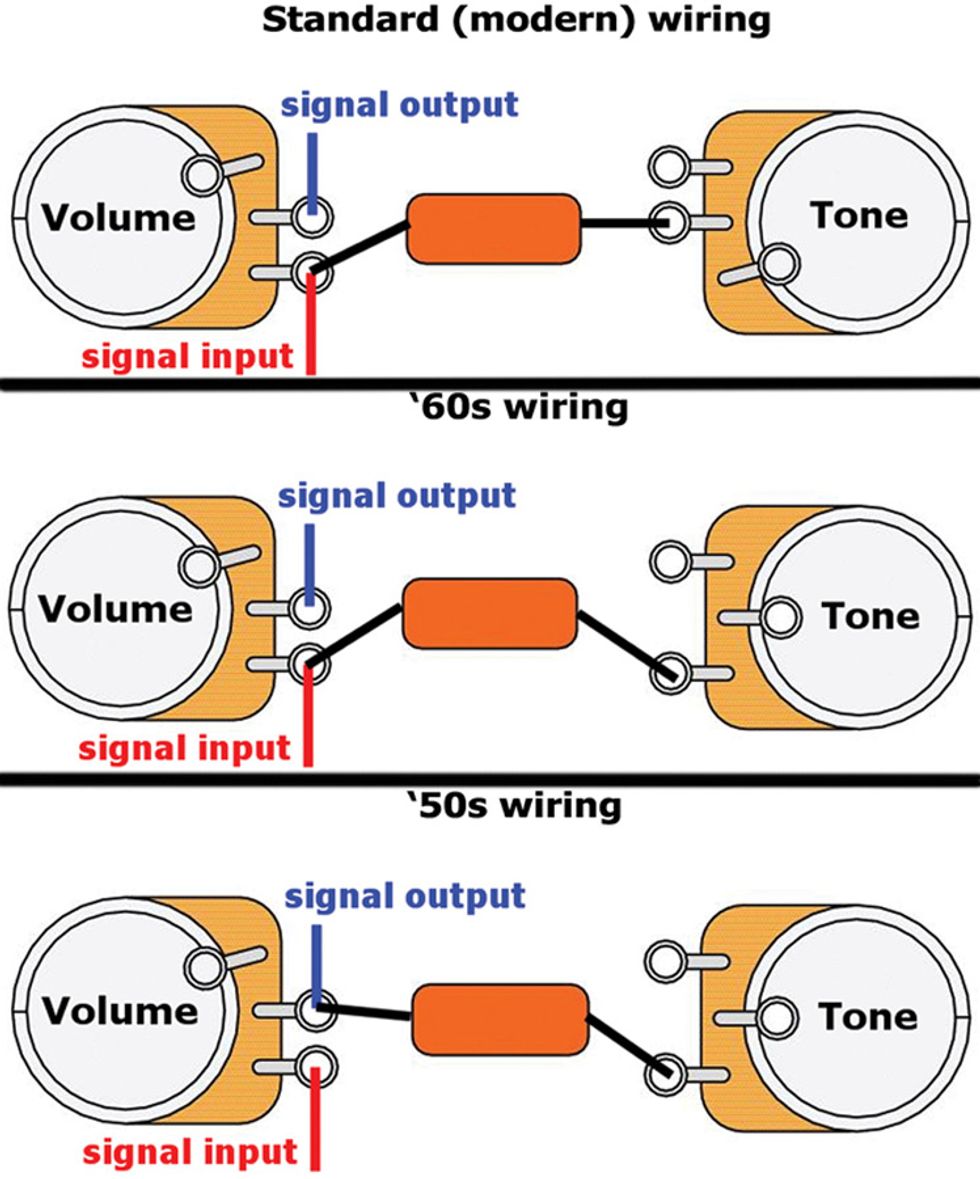
From the article:
The tone cap connects to the volume pot’s output lug, rather than its input.
What’s so special about the ’50s wiring? It will influence the guitar’s performance in three major ways:
1. The overall tone gets stronger and more transparent. It’s difficult to describe, but I think of it as more “in your face.”
2. The typical treble loss that occurs when rolling back the volume is greatly reduced, and both the volume and tone controls react more smoothly and evenly without the typical hot spots. As a side effect, it’s easier to clean up an overdriven amp by simply rolling back the volume on your guitar a bit.
3. The tone and volume controls interact with each other—something you may know from certain early Fender tube amps. When you change the volume, the tone also changes a little bit and vice versa. Such interaction may feel strange at first, but it only takes a few minutes to get used to.
2. The typical treble loss that occurs when rolling back the volume is greatly reduced, and both the volume and tone controls react more smoothly and evenly without the typical hot spots. As a side effect, it’s easier to clean up an overdriven amp by simply rolling back the volume on your guitar a bit.
3. The tone and volume controls interact with each other—something you may know from certain early Fender tube amps. When you change the volume, the tone also changes a little bit and vice versa. Such interaction may feel strange at first, but it only takes a few minutes to get used to.
I've cut out a lot of the technical jargon, so I'll boil it down here. The main problem with modern wiring is when you roll back the volume or the tone knobs. Simply put, it doesn't sound great. When backing off the tone knob, the biggest problem is the loss of volume in the high/treble sounds.
So I decided to use my Guild Bluesbird as a guinea pig for this project. I've written about it before. Here's the link:
In that blog post I showed a few mods that I had made to "squeeze the tone" out of it. Namely, I replaced the Alnico 5 magnet in the 59 neck pickup to an Alnico 2. I also changed the cheap ceramic caps out for "Tropical Fish Capacitors." (Yes, that really is what they are called.)
So here is the guitar we are working with.

And here is the inside control cavity.

Let's fast forward to changing the wiring.

Honestly, it wasn't that hard or time consuming. But here's the question... did it deliver promised results? I mean, I've heard a lot of rumors, inuendo, and B.S., but did this actually work?
Yes. Yes it did. I noticed a huge difference. The sound really was more, "In your face" as described by the article. Where I really noticed it was turning down the tone pots. The high/treble sound didn't drop out like it had done before. In other words, there was no loss of volume of the high/treble notes.
I also noticed the pickups sounded much brighter. The 59' neck pickup (with an Alnico 2 magnet) sounded extremely balanced. They might be considered too muddy for high gain/metal players. But with 50's wiring it sounded amazingly balanced and soulful.
The 59' bridge pickup (stock) was much brighter. It actually reminded me of 1950's music. I know all the advertisements like to say their vintage pickups are warm, blah, blah, blah, etc. Have you ever listened to late 50's/early 60's music? Think of the Beach Boys. Listen to them and realize how bright their sound is. I know they are playing Fender instruments, but still, the 50's sound was pretty bright.
With 50's wiring the Seymour Duncan 59' sounds exactly like it rolled off the line at Gibson back then. What also surprised me was that the bridge pickup had quite a bit of bite that it never had before. I think some folks might mistake it for a Seymour Duncan Pearly Gates pickup due to the amount of bite it had.
The verdict? The verdict is yes. In fact, it's a huge yes! In complete honesty I didn't think it would make that much of a difference. And the one thing I hadn't thought of was, "How do different types of capacitors react with 50's wiring?" Those paper in oil caps might make a bit of a difference with 50's wiring.
I already had quality Tropical Fish Capacitors installed in the Bluesbird. So I'm not sure how much (or little) of an upgrade they are over cheap ceramic caps. But to get back to the point, 50's wiring really did make that much of a difference. I'm going to be doctoring a few of my guitars in the coming weeks.
I am thankful for Premier Guitar for running the wiring article. I am reminded of what a violin luthier told me. He said, "We can make anything as good as Stradivarius these days due to sharing so much information. We don't have to keep reinventing the wheel every ten years."
So I have written this blog post to keep sharing information. I believe it's important. I've seen the quality of guitars skyrocket in the last twenty years. I've seen the parts on those guitars skyrocket as well. Sharing information is pivital to making amazing music. I hope I've helped you out some.


