Showing posts with label pickup. Show all posts

Sunday, March 10, 2019

New Pickup Day: Dragonfire Gatebucker Review

As a musician I am always on a quest for tone.  I am fascinated by sound, and they way it can be expressed.  A few months ago I wrote a blog post about a set of pickups I bought at the Orlando Guitar Expo.  They were a set of Seymour Duncan 59 neck/Pearly Gates Plus bridge pickups.    I installed this set of pickups into an Epiphone Les Paul of mine.  The sound was amazing.  

Here's the link to that blog post.


The sound of the Pearly Gates set got me to thinking.  I looked up specs, EQ, and anything could find about the pickup set.  One thing caught my eye.  The price.  Back when I started getting interested in playing guitar, circa 1998, one Pearly Gates pickup cost $50.  Nowadays, that same pickup costs $120.  A set costs $240.  

So this lead me to more thinking.  Do any other pickup makers make a Pearly Gates clone?  After being in this business for a while I had many contacts.  I looked through a lot of pickup makers, but no one offered anything even remotely close to a Pearly Gates clone.  That is, except one.  

I was looking at the Dragonfire Guitars website.  Yes, the company that looks like it's website was designed in 1997, and hasn't changed since.  I can't lie, it needs an update.  But in their offerings of pickups was something called a "Gate Bucker."

Here's the link:


They were selling the Gate Buckers set for a grand total of $60.  Not $60 a piece, but both pickups for a total of $60.  At first I passed on the deal.  I thought, "How good can they be if they are even cheaper than GFS pickups?"  

Also was the fact was the guitar I was going to put them in was an Epiphone Les Paul that had the new wiring system in it.  That's the one with the quick connect system.  It's not hard to wire it up, it's just time consuming.  And if I hated them, then it would be a pain to rewire it all again.  

So I looked some more around the net.  I still couldn't find anything close to the Pearly Gates set.  I ended up searching Reverb, www.reverb.com and the Gate Bucker set came up.  It got me to thinking... yet again.  I thought, well, I'm going to just have to give this set a shot.  

So I went ahead and ordered a set.  The company was great to deal with, and worked quickly to ship me the pickups.  As soon as I received the pickups I installed them.

Here they are.


Again they look like any other pickups, but something surprised me when I flipped them over.  Take a look.


Do you notice it?  These pickups actually have nickel/silver baseplates.  They may have not cost a lot, but they surely weren't cheaply made.  


So I started installing them right away.  Like I mentioned earlier I would have to deal with Epiphone's quick connect system.  That meant cutting the 5 wire connector  Next, I had to make sure I matched up the correct wires.  Dragonfire and Epiphone use different color codes.  After that I had to wire up five wires for each pickup.  

One of the best things I bought was a variety pack of heat shrink wire tubing.  That way I could cleanly connect the wires, and then use a larger heat shrink tube to hold all the smaller ones together.  Here are the photos so you can understand what I'm talking about.

  
As you see each pickup has five wires that I connected.  


It occurs to me now that I didn't take any photos of my blue Les Paul.  It is amazingly beautiful.  But in this photo you can see the edge of it.  Also in the photo are the pickups laid out.  At this stage I am going to put the large tubing over the end of the pickup wire.


Not too shabby, huh?  The important part is that it worked the first time.  Of course, I made sure to check my connections before any of the tubing went over any part of the wires.  

But now it was time for the sound check.  How would a cloned pickup that cost 1/4 of it's subject sound?  Would it sound only a quarter as good?  One thing that worried me was that the Gate Bucker had matched coils.  The Pearly Gates coils aren't exactly matched up.  That's one way it gets it bite among other things.  

So I plugged it in and was surprised.  The bridge Gate Bucker matched up really closely to a Pearly Gates pickup.  On a Pearly Gates bridge pickup the top three strings (E, B, G) are really bright, and almost separate themselves from the bottom three strings.  The bottom three strings (D, A, E) are bluely and a touch loose.  But overall, all the strings had a bite to them.  

I know it's tough to say a pickup's bottom is loose but still has bite, but I have to stand by that opinion.  I will say that the Gate Bucker doesn't have as much bite as the pickup it's based on, but I think I know why.  Like a lot of overseas made pickups, the Gate Bucker is filled with wax.  I am in favor of light wax potting, but the overseas made pickups are just soaked in wax.  

When soaking a pickup in wax it's innevitently going to kill off the highs and the bite.  I know some boutique pickup winders won't wax pot a pickup.  If they are requested to do so. they lightly pot the pickup so only the outer windings are wax potted.  This leaves the inner windings untouched.  

So my final grade for the bridge Gate Bucker pickup is an "A."  I have to admit I was shocked.  I didn't think an overseas made pickup could sound so close to a Seymour Duncan pickup.  So now onto the neck pickup. 

The neck Gate Bucker was what I would call a Blues Machine.  It had rounded off treble, but was very nicely balanced.  I would say it's not for everyone.  And by that, I mean, those would turn their gain up to "dentist drill" setting.  But if you love rock n' roll, and want a neck pickup that has tone that will express how your soul feels the Gate Bucker neck pickup is for you.  Again, I would give it an "A."

I am thankful that I took a chance with the Gate Buckers.  I may have to write Dragonfire Guitars and tell them just how wonderful their pickups are.  That, and to completely update their website.  Seriously, they really need to do something about that.  

But I will say, I am going to keep the Gate Buckers in my favorite blue Les Paul.  I think they are without a doubt my sound.  Well, at least until my search for tone takes me elsewhere.  

Friday, December 28, 2018

New Guitar Day: Agile 2500: Not Impressed

It finally happened.  I had a bad "New Guitar Day."  It was bound to happen sometime in my lifetime.  But some of this is on me.  Let me start at the beginning.

As I was looking over the Rondo Music website, home of Agile Guitars, I saw a B-Stock guitar that was exactly what I was looking for.  It was a Les Paul style guitar with P-90's.  I didn't want the P-90's so much as I wanted the P-90 route.  I was going to put mini-humbuckers in it.

It's easier to find a Les Paul style guitar with P-90's than mini-humbuckers.  Since I was going to change pickups anyway, even if it had mini-humbuckers, I looked for the best deal I could find.  Unfortunately, that came to bite me in the butt.

So this blue flamed, Les Paul styled guitar was actually marked down quite a bit in price.  It was considered B-Stock due to some damage on the fingerboard.  I thought, "Well, that's nothing.  I'm sure to accidentally bang it around in the first week.  It's going to have more dings than that in a short time."


So I bought it at a greatly discounted price due to the damage and finish imperfections.  When I received the guitar I had so much going on I didn't actually play it.  I took it out of the box, and put it on my workbench.  I then went out of town for a few days.  So I had it for a bit before even getting to mess around with it.

Once I played it I noticed the action was insanely high.  I thought, "Well, it probably just came from South Korea, and no one has even looked at it.  No matter."  But matter it did.  Usually when I start work on a guitar I do everything at once.  This was no different.

I started with a fret dress.  I then removed the P-90 pickups.  I realized to fit the mini-humbuckers I would have to do a few modifications.  Namely, I needed to cut holes in the route so that the pickup feet would fit.

Here is what it looked like after I cut the holes for the feet:


I also had to drill holes for the mini-humbucker pickup rings.  (Note: not pictured.)  That took a bit of time and effort as the rings just barely covered the hole.

After a lot of back and forth I managed to get the mini-humbuckers installed, I started to set the guitar up.  That's when I noticed I was having problems with frets, 14, 15, and 16.  I still had dead spots.

I couldn't figure out why that would be.  That is, until I looked down the neck.  It was then I discovered that where the neck met the body, the heel was kicked up.  I was instantly furious.  Not just at myself, but at Rondo Music for letting that guitar out of the factory.

For those who know me, know I worked as the repair department for Dean Guitars.  At Dean we never would have let a guitar like that be sold, even as B-Stock.  It should have been marked at X-Stock, stripped of it's parts, and the body destroyed.

I wrote Rondo Music since they don't have a publicly listed phone number.  I told them I had modified the guitar, but since it shouldn't have been sold in the first place, could I return it?  Frankly, I received a lot of attitude in the message back.

I wrote explaining that I was, in fact, a luthier who actually went to luthiery school, and apprenticed under a master luthier.  I told them that guitar should have never left the factory.  I'll admit, I told him that when I received the guitar, the strings were so high you could shoot arrows off of it.  Of course, they had the action that high so it would make the 14th, 15th, and 16th frets playable.

What I received back was an E-mail critical of my skills.  It also stated that they dealt with 50,000 guitars, and knew what they were doing.  Also, if I had bought a Ford or Chevy, modified it, and tried to return it, would the dealer accept that return?  He didn't think so.  But he finished the e-mail saying, just return it, and they would see what they could do.  He wasn't promising anything.

I'll admit, I was pretty hostile.  The e-mail was written in a very nasty tone.  So I went to work on the guitar.  I took the mini-humbuckers out, and reinstalled the P-90's.  It was then a thought occurred to me.  If I sent it back, they would just try to set it up and then send it back to me.  Well, since they did such a shitty job the first time, why would I trust them to do it a second?

So I set the guitar up to where it would be playable.  That way, if they said, "Nothing was wrong with it," I would know they didn't even try.  That, or they have some really lazy and incompetent people working there.  So I set it up.

I raised the action on the high E (treble) side.  I had both sides at 2/32nd's.  That basically what I set a Floyd Rose equipped guitar to.  That way, players can dive bomb or pull back as far as possible and it won't fret out.  Would you know that just raising it that much cleared it enough so that all notes were playable?  Again, I was furious at myself for not trying that earlier.  I just got into too much of a hurry.

So now I had a dilemma.  If I sent the guitar back, they would look at it, play it, and say there's nothing wrong with it except for the holes I drilled in it.  They would then just send it back to me leaving me in the same place I was before.

So after consulting a friend I decided that I wouldn't return it.  When it comes down to it I modified the guitar.  After fret-dressing and setting the guitar up correctly there was nothing Rondo Music could do with it.  I doubt I was going to get a refund, so why bother trying to return it?


So I wrote a very straight-forward e-mail saying, "After continuing work on it, I made the guitar playable.  Since I had modified the guitar I understand I couldn't return the guitar for a refund."  I left it at that.  I also received a very simple return message that said, "Thanks for the update."

Now, I understand I should have looked the guitar over before I started work on it.  I'm just so used to performing all my work at once.  I've found there's not much I can't do, but I'm used to working on guitars that would pass a basic inspection.

What upsets me is the way the e-mails were worded.  They came across as pretty nasty.  I mean, I'm actually a returning customer.  That's right.  I bought an Agile guitar four years ago.  I wrote a blog about it.  Here it is:

New Guitar Day: Christmas Edition


So it's not like I've never dealt with Rondo Music before.  I like my Root Beer colored Agile.  I thought it was a better quality guitar than any of the comparable South Korean made Epiphone Les Paul's.  But this blue 2500 fell far from the tree.

And the lousy thing is I put the P-90's back in it.  I have been working myself back up to putting the mini-humbuckers back in it, but I just haven't had the motivation.  In fact, I forgot to take photos of the guitar with the mini-humbuckers in it, hence, why none are posted on this blog.

Eventually I will get around to installing the mini-humbuckers.  After I do that I'll post a blog reviewing them.  The pickups I bought were a set of Alnico 2 mini-humbuckers by Artec.

Again, what upsets me about this guitar is the way I was treated, and that Rondo Music would let a guitar like that leave their factory.  I have it playing alright, but it should be so much better.  I'm also hoping that the kick up at the heel doesn't get worse with time.  Right now, I'm not sure I will ever buy from Rondo Music again.

Les Paul Madness: Part 2: Pickup Madness!

Please start with Part 1.

Les Paul Madness: A Guitar, A Case, A Great Deal, And A Lot Of Work

I really enjoy playing my Epiphone Les Paul Custom.  I performed a lot of work on it to make it play this awesome.  But I had a problem.  (A white people problem.)  I did not like the bridge pickup at all.  So I made a few changes.  Here's the list.

As I wrote in Part 1 of this blog post, I started with a Dean Mountain of Tone pickup in the bridge position.  Basically it's Dean's version of Seymour Duncan's Custom 5 pickup.  I hated the lack of mids in it.  It just wasn't my sound.

What's funny is that I actually have a Seymour Duncan Custom 5 in my parts drawer.  Since I really disliked how it sounded, I performed a magnet change on it.  I learned about changing magnets from the Seymour Duncan Forum.  It's been a great way to achieve new sounds from pickups.

For those who don't know the Custom series pickups are all the same wind with a different magnet.

Custom = Ceramic magnet.
Custom Custom = Alnico 2 magnet.
Custom 5 = Alnico 5 magnet.  (AKA, jokingly called the "Custom Custom Custom.")

So I changed the Alnico 5 magnet out for a ceramic.  That way I would end up with the original design of the Custom pickup.  It had a bit more mids, but I still didn't care for it.  So back to the workbench.

Next, I changed the ceramic magnet for an Alnico 8 magnet.  Now, Seymour Duncan doesn't actually make a "Custom 8" pickup, but that's what the folks on the Seymour Duncan forum call it.  I tried it, but I still thought it was thin and just not that great.

I was aiming to change the Alnico 8 magnet for an Alnico 2 magnet.  However, I saw and bought an interesting pickup off of Ebay.  Anyone who knows me, knows I love bladed pickups.  And on Ebay I saw a bladed pickup with a silver baseplate for only $19 plus free shipping.  I thought, "I have to try this out."

So I tried it out.  You know what?  I loved it.  The sound fell right between a Bill Lawrence (Wilde pickups) L-500-R and an L-500-L.  And that's the sound that I have been looking for.  For years I've used an L-500-R in the bridge.  It is a very PAF meets bladed pickup sound.  In other words, mid-scooped with lots of bite.


I've tried the L-500-L, and it's a bit compressed for my taste.  The L-500-XL does metal really well, but I wouldn't use it for anything else.  So this new pickup is what I have been looking for, for a long time.

You can find it listed as: Twin Blade High Output Bridge Output Humbucker Pickup Black Nickel Silver Baseplate.  The seller is sanman8753.

So I thought, "Why stop there?  Let's find a matching neck pickup."  Well, the seller didn't have a matching neck pickup, so I searched for one.  95% of the bladed pickups were for the bridge position.  However, I found one neck pickup that intrigued me.  What got my attention was that it also had a silver baseplate.  It was, however, a bit more expensive than the bridge pickup.  It cost $38, but had free shipping.  It still cost less than a GFS or equivalent pickup.

You can find it posted as:  New Alnico V Twin Blade Rail Hot Humbucker Guitar Pickup Neck or Bridge - Black.  The seller is: Allsoundstore.


If you will notice, the blades are a lot thicker on the neck pickup.  I think this brought out a much thicker sound.  It has a bit more mids than an L-500-R.  I'd say the treble is about the same.  The real difference is that the bass is huge on this pickup.  I will say it had a lot more compression than the L-500-R.

I brought the treble side up to the strings where I normally do, but I had to lower the bass side since the bass was too overwhelming.  After I did that it seemed to find it's sweet spot.


The good news, is that, the pickups blended well.  I really dig the sounds I can get out of this guitar now.  Surprisingly, I can achieve some really interesting and usable sounds using the tone controls.  I didn't get to play it as much I would have liked today, but I am looking forward to playing it in the future.

Wednesday, October 17, 2018

Les Paul Madness: A Guitar, A Case, A Great Deal, And A Lot Of Work

Boy I really have a problem.  I can't say no to a great deal when it comes to musical instruments.  The crazy thing is that, the market is so flooded right now deals are popping up all the time.  Honestly, I don't even look at a used instrument unless it's at least half off its new retail price.

I have always wanted a black Les Paul Custom.  Of course, I know I can't afford a Gibson, but I am more than happy with an Epiphone.  So when one popped up on Craigslist I had to take a peek.  It turns out I had just bought a pickup from the seller of the Epiphone a few weeks before.  He was selling the guitar along with an Epiphone hard-shell case for $275.

If you check Sweetwater you can see that an Epiphone Les Paul Custom now costs $679.00 new.  The hard-shell case runs $129.00.  So you can see why I jumped on this deal.  When I checked out the guitar I saw why he was selling it so low.  The frets were all ate up.  Someone had played this guitar until the frets just didn't need fret-dressed, they needed replaced.

But that's okay since guitar repair is what I do.  I'd not only re-fret the guitar, I'd buff out all the pick scratches, and change out the pickups.  Here's what I was working with.


My camera isn't a high end camera, but I took a photo that tried to show the pick scratches.


First up, let's take a peek at those frets.  My camera actually managed to get a someone decent photo of how chewed up they were.


Next I stripped the guitar of it's body hardware and removed the pickups.


Next it was time to remove the frets.


You can see just how roughed up the wood was.  There were dips in the fretboard where it had been played heavily.  So now it was time to use a radius block, and then a wood planer.


I radiused the fretboard until it was nice and smooth.  I should also mention that before I started sanding I made sure the neck was completely flat.  In other words, I adjusted the truss rod until it was nice and flat.

After I wiped the dust off here's what it looked like.

Not bad, huh?  That looks 100 times better.  Next up I used my tiny saw to clean out the fret slots.  Since I had removed old frets and slung rosewood dust everywhere, the slots needed cleaned out.  I took my time, and cleaned them until my tiny ruler measured the slots 4/32nds deep.

In the above photo you can see my small saw and ruler.  In one of those, "Ounce of prevention/pound of cure," ideas, cleaning out the slots really helps in the long run.  If there's not enough room for the tang to sit in the slot the fret just won't go in.

Next up I used my curling tool to curl up my fretwire.  I decided on using "Dean" style guitar wire.  In other words, it's taller and wider than most fretwire.  That's okay since I am going to fret-dress it which brings down the overall height.

Next up, I cut the wire into individual frets.  I used my tang-nipper to cut the inside tang to size.  I usually work with three frets at a time.

Titebond 2 is my go-to glue of choice.  I put glue in the slots, and hammered the frets in the old fashioned way.  I like using rubber bands to hold them in.

We'll fast forward to where I installed a lot of frets.


Of course, the questions is, "What do I do when I can't reach a rubber band behind a fret?  Simple.  I grab my radius block and clamps.  They'll put enough pressure to hold the frets down.


Now comes the part that a lot of people don't want to do.  Letting the glue dry.  That's right.  I give the glue 48 hours to dry before I continue working on the guitar.

Next up I remove the clamps, block, and rubber bands.  I use my fret cutters to cut the fret-ends.


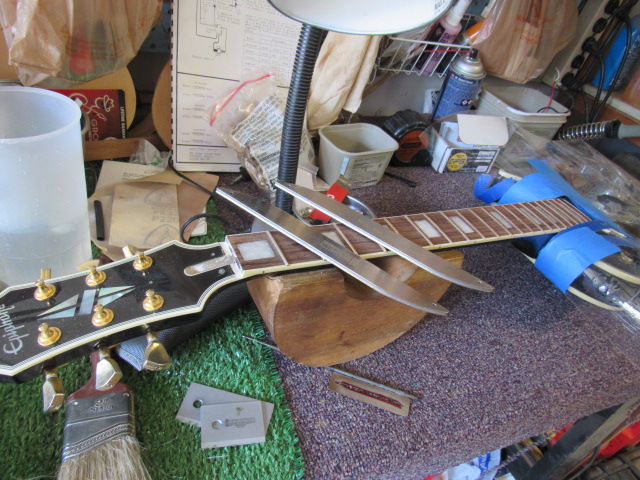
Now I use a special angle file to even up the edges of the frets.

Next up I use a special triangle file to file the edges of the frets.  Different luthiers will do this step in different places.  I perform it here, and sometimes a second time after fret-dressing.  Players really hate it when they cut their fingers while sliding on bar chords.  I don't blame them.

This triangle file is special since the corners are smooth.  That way I can file the frets in the way shown below.

A step that I've found to be very important is to use a marker and mark the top of the frets.  That way, when I am performing a fret dress I can see where my file is cutting.


Now if I were doing this on a maple fretboard I would tape up everything but the frets.  Since this is rosewood I am just going to buff the snot out of it anyway.  Some luthiers would tape up the fingerboard no matter what kind of wood was used.  It's really just personal preference.

Also, please notice the plastic sheet that I use to protect the body.  This works great.  It's much better than laying down 1000 feet of masking tape like I've seen some luthiers do.


My next step was to fret-dress the frets.  I'd use my fret file to even out the frets.  Once they were flat, I used my "high tech" block of wood to sand it down even finer.  I attached coarse 80 grit sandpaper with duct tape, and ran it back and forth on the frets.


Next up, I used a 150 grit diamond fret file, and then a 300 grit diamond fret file.  I should also mention that I use my straight-edges repeatedly throughout this step.  I have to be sure that the frets are as perfectly straight as can be.


After that, I used my "high tech" homemade block of wood. This time I attached 120 grit sandpaper to my block of wood with duct tape.  Again, I ran the block of wood back and forth to make sure the frets were perfectly even.  Again, I am using my straight-edges throughout this step.


Next up I used my fret shields while I sanded down and smoothed the frets.  I like using 220 grit followed by 320, 400, and finally 600.

My next step used to be taking steel wool to the frets, but 3M has a new product that's much better and not as messy.  They make these Scotch-bright pads that shine up the frets, but don't damage the wood.  They also don't leave behind little pieces of steel wood that seem to magically attach themselves to your guitar pickups.

The gray one is equal to #00 steel wool, and the white one is equal to #0000 steel wool.  See what a great job they do on the frets and fretboard?


The next step that I've found really makes a difference is using a buffer.  Now I was going to use it anyway to buff out the guitar pick scratches, so this made it easy to just go over the entire guitar.

I used the three step buffing process, and it worked great.


After buffing the guitar out I checked the frets out with my straight-edges one last time.  It measured perfectly flat.  This would normally be the time where I would add some sort of oil to the fretboard.  However, I kind of forgot this time around.  So next time I change strings I will do that.

So next up was time to put the hardware back on, and install new pickups.

I decided to go with my favorite Schaller Golden 50 in the neck, and the Dean Leslie West, "Mountain of Tone" signature pickup in the bridge.

Once I installed them I had to set the guitar up.  The big things to take care of were the string height, and adjusting/filing the nut slots.  The intonation was perfect, and I only had to adjust the truss rod a little bit.


I have to say it feels good bring this guitar back to life.  The "Mountain of Tone" pickup sounds a lot like a Seymour Duncan Custom 5.  Which to me isn't that great.  I never cared for the Custom 5, but this pickup sounds okay.  I'll play it some, and see how I feel about it.  But the lack of mids just make it seem like a weak pickup to me.

Next up I will be adding straplocks and a strap.  Luckily I have some gold straplocks from years ago.  I just never had a guitar to put them on until now.  I'll end up playing this one for a while, and see how I feel about it.  I'll see if I bond with it, or move it down the road.  I will say I'm glad I had the chance to perform all this work on it.  I think I enjoy working on them more than I do playing them these days.