About a month ago I had a longtime friend of mine decide to clear out some of his old basses. He's a touring musician, and has collected quite a few instruments. He told me that he's made a lot of friends across the country, and would pick up instruments at great deals. But all those great deals were taking up space in the house, so a few had to go.
He posted a photo of a Squier Classic Vibe 60's Jazz Bass, and said he was happy to let it go for $100. I immediately said, "That's an awesome price. Someone will snatch that up for sure!" I would have bought it, but I already had a Dean Juggernaut bass. That's their version of the Fender Jazz Bass.
But then I got to thinking. I remembered when the Classic Vibe Jazz Bass series came out. It was everything I wanted in a bass. The Olympic white with red tortoiseshell pickguard was the exact color scheme I love in a Fender type guitar/bass. I also really liked the fact that the neck was a golden vintage tint with a rosewood fretboard.
After about two weeks I messaged my friend, and asked him, "Say, has anyone bought that bass from you yet?" Shockingly, he said, "No." When those basses were new they cost $400 plus tax. $100 was a steal. So I told him, "I had to have it! When can I drop by?"
So I dropped in the next day, and handed over the cash. I wish we could have talked more, but with the Covid-19 craziness happening we had to keep it short. But it was good to see him, even if for a short time.
I immediately loved the bass. The set-up was different than how I set up a guitar or bass, but somebody really took the time to make it easily playable. What has shocked me the most on the entire Squier Classic Vibe series are the pickups. They have installed some extremely awesome pickups for a guitar or bass at that price point.
Before I go into my tinkering I'll post some photos of her.
I have to say someone had performed a wonder fret-dress on this bass. It was smooth. Again, everyone has preferences on how they like their instrument set up. With this bass I decided to shim under the neck. This way it would lower the strings from the fifth fret up.
I know I said I loved the pickups, but I still had to tinker with them. A few weird coincidences happened. I had a Jerry Sentell Jazz Bass bladed bridge pickup that was going to go into another build. That build never happened so I've had it laying around for a while.
I also managed to snag a used Seymour Duncan Vintage Jazz Bass neck pickup for a good price. So I installed both pickups into this bass. I also used some really thick and strong foam to push the pickups up closer to the strings. I also changed the strings to my usual GHS Boomers. I also prefer to install Fleor strap-locks, so I did that as well.
All in all it didn't require too much work on my part. I cleaned it up a bit with my favorite Ken Smith polish. I also used a large paintbrush to knock some of the dust away from the bridge saddles, but after that I could call it a day.
I gotta say I'm having fun with it. I don't play bass that often so it takes me a while to get back into the groove when I pick one up. Now I just have to find a place to keep it. Like my friend I'm starting to run out of room here. Oh well. Such is the life of musicians.
I look at life a bit differently, and like to post my weird thoughts. I like musicial instrument repair and woodworking. For trying to live a somewhat normal life, a lot of weird things happen to me. Instead of putting up with it, I post about it in this blog.
Showing posts with label Seymour Duncan. Show all posts
Wednesday, May 6, 2020
Tuesday, March 31, 2020
Chasing Tone: 50's Guitar Wiring
As you know, I, like many other musicians, are always on a quest for tone. I've written many posts on this blog about the subject. Whether it is guitars, pickups, electronics, or capacitors, I am always on the hunt for a way to achieve the perfect. tone.
I came across an article a few weeks ago that was talking about a surprisingly easy and inexpensive way to improve the tone of a guitar. Here's the link:
Mod Garage: Three Ways to Wire a Tone Pot
The author brought up a good point. We look to the 1950's Gibson PAF pickups as the "Holy Grail" of all pickups. But in all honesty, pickup makers today can create pickups that are just as good, if not better than those vintage PAF pickups. So what's the difference?
As I've written before, many players are extremely fickle about their tone capacitors. Some claim they can hear the differences between cheap ceramic caps and paper in oil caps. Here are a few blog posts I wrote about trying out different caps.
Squeezing The Tone
Squeezing the Tone, Part 2
Long story short, changing the capacitors did nothing for me. For the heck of it I bought an old Russian paper in oil cap, and soldered it into my Dean Dixie Rebel. Honestly, I couldn't hear a bit of difference. That cap cost me $5, and that's on the cheap side. The modern day Emerson paper in oil caps cost $20 a piece. Let's be honest, $20 is way over the top for a capacitor.
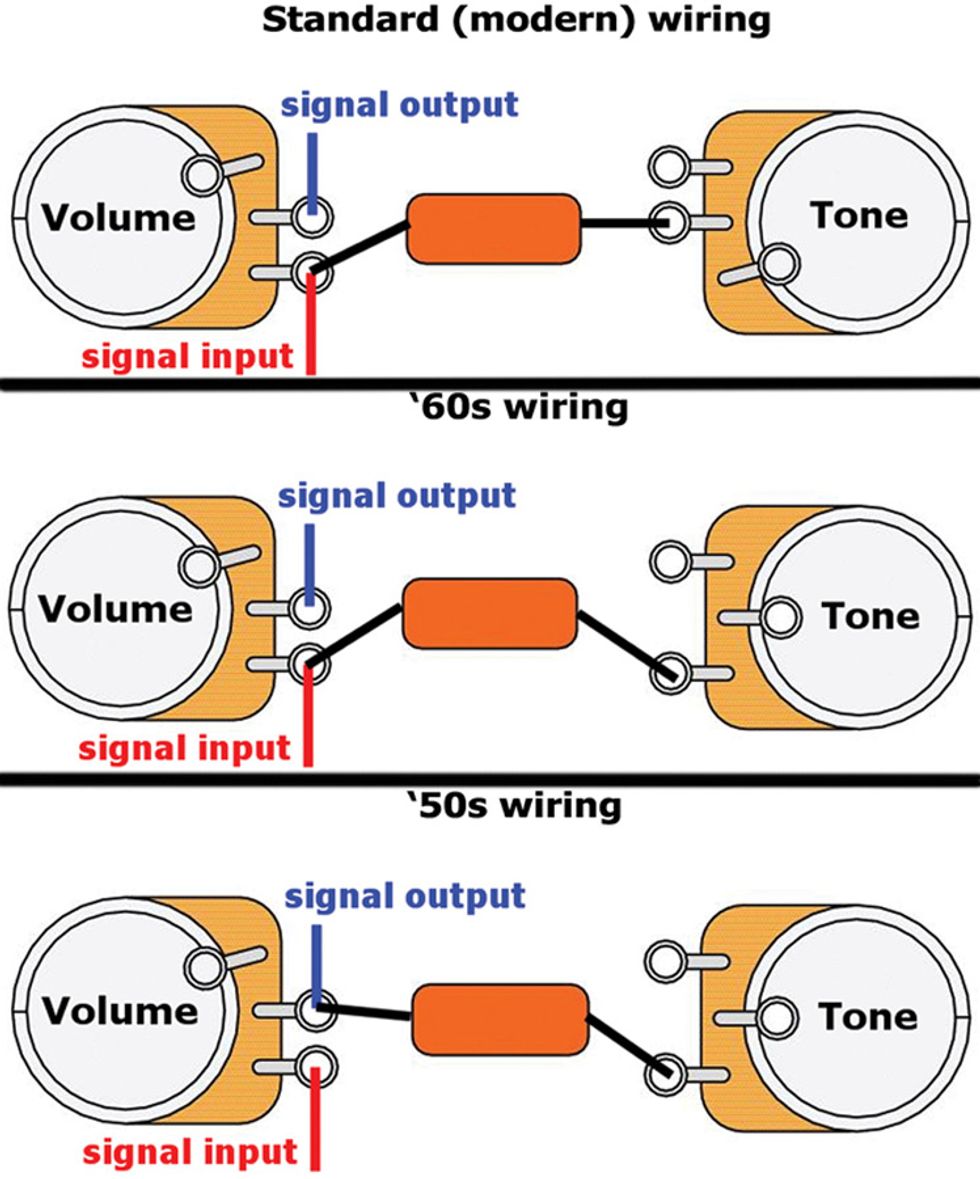
So when I read the article posted above I originally took it with a grain of salt. But the author said something that I hadn't thought of. We accept those PAF pickups as the "Holy Grail" of pickups, but we are forgetting one thing. They were also wired with 50's wiring.
Now I know you are wondering, "What does that have to do with anything?" Well take a peek here.

From the article:
I came across an article a few weeks ago that was talking about a surprisingly easy and inexpensive way to improve the tone of a guitar. Here's the link:
Mod Garage: Three Ways to Wire a Tone Pot
The author brought up a good point. We look to the 1950's Gibson PAF pickups as the "Holy Grail" of all pickups. But in all honesty, pickup makers today can create pickups that are just as good, if not better than those vintage PAF pickups. So what's the difference?
As I've written before, many players are extremely fickle about their tone capacitors. Some claim they can hear the differences between cheap ceramic caps and paper in oil caps. Here are a few blog posts I wrote about trying out different caps.
Squeezing The Tone
Squeezing the Tone, Part 2
Long story short, changing the capacitors did nothing for me. For the heck of it I bought an old Russian paper in oil cap, and soldered it into my Dean Dixie Rebel. Honestly, I couldn't hear a bit of difference. That cap cost me $5, and that's on the cheap side. The modern day Emerson paper in oil caps cost $20 a piece. Let's be honest, $20 is way over the top for a capacitor.
So when I read the article posted above I originally took it with a grain of salt. But the author said something that I hadn't thought of. We accept those PAF pickups as the "Holy Grail" of pickups, but we are forgetting one thing. They were also wired with 50's wiring.
Now I know you are wondering, "What does that have to do with anything?" Well take a peek here.

From the article:
The tone cap connects to the volume pot’s output lug, rather than its input.
What’s so special about the ’50s wiring? It will influence the guitar’s performance in three major ways:
1. The overall tone gets stronger and more transparent. It’s difficult to describe, but I think of it as more “in your face.”
2. The typical treble loss that occurs when rolling back the volume is greatly reduced, and both the volume and tone controls react more smoothly and evenly without the typical hot spots. As a side effect, it’s easier to clean up an overdriven amp by simply rolling back the volume on your guitar a bit.
3. The tone and volume controls interact with each other—something you may know from certain early Fender tube amps. When you change the volume, the tone also changes a little bit and vice versa. Such interaction may feel strange at first, but it only takes a few minutes to get used to.
2. The typical treble loss that occurs when rolling back the volume is greatly reduced, and both the volume and tone controls react more smoothly and evenly without the typical hot spots. As a side effect, it’s easier to clean up an overdriven amp by simply rolling back the volume on your guitar a bit.
3. The tone and volume controls interact with each other—something you may know from certain early Fender tube amps. When you change the volume, the tone also changes a little bit and vice versa. Such interaction may feel strange at first, but it only takes a few minutes to get used to.
I've cut out a lot of the technical jargon, so I'll boil it down here. The main problem with modern wiring is when you roll back the volume or the tone knobs. Simply put, it doesn't sound great. When backing off the tone knob, the biggest problem is the loss of volume in the high/treble sounds.
So I decided to use my Guild Bluesbird as a guinea pig for this project. I've written about it before. Here's the link:
In that blog post I showed a few mods that I had made to "squeeze the tone" out of it. Namely, I replaced the Alnico 5 magnet in the 59 neck pickup to an Alnico 2. I also changed the cheap ceramic caps out for "Tropical Fish Capacitors." (Yes, that really is what they are called.)
So here is the guitar we are working with.
And here is the inside control cavity.
Let's fast forward to changing the wiring.
Honestly, it wasn't that hard or time consuming. But here's the question... did it deliver promised results? I mean, I've heard a lot of rumors, inuendo, and B.S., but did this actually work?
Yes. Yes it did. I noticed a huge difference. The sound really was more, "In your face" as described by the article. Where I really noticed it was turning down the tone pots. The high/treble sound didn't drop out like it had done before. In other words, there was no loss of volume of the high/treble notes.
I also noticed the pickups sounded much brighter. The 59' neck pickup (with an Alnico 2 magnet) sounded extremely balanced. They might be considered too muddy for high gain/metal players. But with 50's wiring it sounded amazingly balanced and soulful.
The 59' bridge pickup (stock) was much brighter. It actually reminded me of 1950's music. I know all the advertisements like to say their vintage pickups are warm, blah, blah, blah, etc. Have you ever listened to late 50's/early 60's music? Think of the Beach Boys. Listen to them and realize how bright their sound is. I know they are playing Fender instruments, but still, the 50's sound was pretty bright.
With 50's wiring the Seymour Duncan 59' sounds exactly like it rolled off the line at Gibson back then. What also surprised me was that the bridge pickup had quite a bit of bite that it never had before. I think some folks might mistake it for a Seymour Duncan Pearly Gates pickup due to the amount of bite it had.
The verdict? The verdict is yes. In fact, it's a huge yes! In complete honesty I didn't think it would make that much of a difference. And the one thing I hadn't thought of was, "How do different types of capacitors react with 50's wiring?" Those paper in oil caps might make a bit of a difference with 50's wiring.
I already had quality Tropical Fish Capacitors installed in the Bluesbird. So I'm not sure how much (or little) of an upgrade they are over cheap ceramic caps. But to get back to the point, 50's wiring really did make that much of a difference. I'm going to be doctoring a few of my guitars in the coming weeks.
I am thankful for Premier Guitar for running the wiring article. I am reminded of what a violin luthier told me. He said, "We can make anything as good as Stradivarius these days due to sharing so much information. We don't have to keep reinventing the wheel every ten years."
So I have written this blog post to keep sharing information. I believe it's important. I've seen the quality of guitars skyrocket in the last twenty years. I've seen the parts on those guitars skyrocket as well. Sharing information is pivital to making amazing music. I hope I've helped you out some.
Labels:
50's wiring,
59',
Alnico,
Bluesbird,
capacitor,
caps,
Guild,
Guitar,
luthier,
luthiery,
Music,
parts,
pickups,
Seymour Duncan,
Tropical Fish Capacitors
Location:
Lutz, FL, USA
Sunday, February 2, 2020
The 2020 Orlando Guitar Expo: Bring Home The Spoils Of Rock!!!
I've been lucky enough to attend the Orlando Guitar Expo for four years running now. I've attended with a few purposes in mind. 1. I usually had something I wanted to trade. 2. I was looking for a few small items for myself. 3. I looked for things I could buy cheaply and then resell. This year I managed to do all three.
So let's get to rockin! First up I was aiming to trade a Hagstrom Ultra Swede w/ OHSC for.... something. The good news, was that, a lot of people were interested in it. I had both attendees and dealers looking at it. I must have showed it to twelve different dealers. Every one of them said the same thing. "Somebody will jump on that."
One reason they said that was because I had it priced extremely fair. When going to the show you have to take a grain of salt with the prices. I had it priced so that they knew I wasn't going to jerk anyone around. And you know, people appreciated that.
I had one dealer who asked to see it, and I was happy to show it to him. In fact, his booth had a big sign that said, "We Buy Guitars!" So he was the guy to show it to. He looked it over and said, "Due to the damage (it was dinged in a corner) he couldn't buy it. " Then he said an almost throwaway line. "I mean, I'd trade for it."
That's when I pointed out a guitar that I'm sure a lot of people passed by. It was a D.B.Z. Bolero. Now for those who don't know, I love Dean Guitars. Their founder Dean B. Zelinsky started a new line of guitars called DBZ Guitars in 2008. They were partnered with Diamond Amps, and later became Diamond Guitars.
But this looked to be a first year model with the original DBZ logo on the headstock. I tried it out, and dug it. It reminded me a lot of my Luna Apollo (owned by Armadillo Enterprises who owns Dean Guitars.) Actually, the DBZ Bolero is the copy of Dean's Soltero. But in all fairness, Dean Zelinsky designed it in 2006.
I asked the dealer how much cash plus the Hagstrom he would want for the Bolero. He thought about it, and said he would take $200 plus the Hagstrom. I thought about it, and said yes. My "Guitar Show" price for my Hagstrom was $350. I would have taken $275 cash for it. So the fact that he gave me $300 credit is a total win for me.
The other good news, is that, the Bolero came with a DBZ OHSC. And I have to say, it's a nice case. So now, onto the pictures!
Next up, I talked to a dealer who had a bunch of parts. He had a bunch of Dimarzio pickups that he just wanted to get rid of. So he cut me a heck of a break. He sold me four of them for $80. I plan on keeping one, and will sell the rest. I ended up buying one HS-3 and three Virtual Vintage Blues pickups.
Also included in the bag were a Fender single coil and a Seymour Duncan Hot Rails. Unfortunately, neither of them were working. But they were free so I can't complain.
The third dealer I bought from was a great seller who I had bought from before. Again, I looked through his parts drawer. I think I must have cleaned him out last year as he didn't have any pickups. But I did manage to find a pitch pipe and a mandolin bridge.
At a grand total of nine bucks I wasn't going to argue with him. He has always been good to me when I've talked to him at guitar shows.
Except for lunch that was all I managed to buy at this years show. I made quite a few loops around the place. It was actually much easier this year since the rain kept regular attendees from coming in early. I didn't let the rain stop me. It's Florida. That's why I carry an umbrella at all times.
So I feel good about the whole thing. I managed to trade the guitar I bought. I brought home an awesome guitar. I also managed to grab a pickup I had always wanted. And I have a few pickups to sell on Reverb to recoup some of my money. All in all that's a great show.
So let's get to rockin! First up I was aiming to trade a Hagstrom Ultra Swede w/ OHSC for.... something. The good news, was that, a lot of people were interested in it. I had both attendees and dealers looking at it. I must have showed it to twelve different dealers. Every one of them said the same thing. "Somebody will jump on that."
One reason they said that was because I had it priced extremely fair. When going to the show you have to take a grain of salt with the prices. I had it priced so that they knew I wasn't going to jerk anyone around. And you know, people appreciated that.
I had one dealer who asked to see it, and I was happy to show it to him. In fact, his booth had a big sign that said, "We Buy Guitars!" So he was the guy to show it to. He looked it over and said, "Due to the damage (it was dinged in a corner) he couldn't buy it. " Then he said an almost throwaway line. "I mean, I'd trade for it."
That's when I pointed out a guitar that I'm sure a lot of people passed by. It was a D.B.Z. Bolero. Now for those who don't know, I love Dean Guitars. Their founder Dean B. Zelinsky started a new line of guitars called DBZ Guitars in 2008. They were partnered with Diamond Amps, and later became Diamond Guitars.
But this looked to be a first year model with the original DBZ logo on the headstock. I tried it out, and dug it. It reminded me a lot of my Luna Apollo (owned by Armadillo Enterprises who owns Dean Guitars.) Actually, the DBZ Bolero is the copy of Dean's Soltero. But in all fairness, Dean Zelinsky designed it in 2006.
I asked the dealer how much cash plus the Hagstrom he would want for the Bolero. He thought about it, and said he would take $200 plus the Hagstrom. I thought about it, and said yes. My "Guitar Show" price for my Hagstrom was $350. I would have taken $275 cash for it. So the fact that he gave me $300 credit is a total win for me.
The other good news, is that, the Bolero came with a DBZ OHSC. And I have to say, it's a nice case. So now, onto the pictures!
Next up, I talked to a dealer who had a bunch of parts. He had a bunch of Dimarzio pickups that he just wanted to get rid of. So he cut me a heck of a break. He sold me four of them for $80. I plan on keeping one, and will sell the rest. I ended up buying one HS-3 and three Virtual Vintage Blues pickups.
Also included in the bag were a Fender single coil and a Seymour Duncan Hot Rails. Unfortunately, neither of them were working. But they were free so I can't complain.
The third dealer I bought from was a great seller who I had bought from before. Again, I looked through his parts drawer. I think I must have cleaned him out last year as he didn't have any pickups. But I did manage to find a pitch pipe and a mandolin bridge.
At a grand total of nine bucks I wasn't going to argue with him. He has always been good to me when I've talked to him at guitar shows.
Except for lunch that was all I managed to buy at this years show. I made quite a few loops around the place. It was actually much easier this year since the rain kept regular attendees from coming in early. I didn't let the rain stop me. It's Florida. That's why I carry an umbrella at all times.
So I feel good about the whole thing. I managed to trade the guitar I bought. I brought home an awesome guitar. I also managed to grab a pickup I had always wanted. And I have a few pickups to sell on Reverb to recoup some of my money. All in all that's a great show.
Labels:
Bolero,
DBZ Guitars,
Dean Guitars,
Dimarzio,
Fender,
Guitar,
Hagstrom,
pickups,
Seymour Duncan
Location:
Orlando, FL, USA
Saturday, December 28, 2019
Partscaster! A Little Buying, Selling, And Rearranging For the Perfect Stratocaster
I know, I know. I need another guitar like I need a hole in my head. But I had been wanting to put together another Stratocaster for a while. It all started when Fender's Mexican line of Stratocasters started being built with two point tremolos. This, of course, had been reserved for their U.S. made instruments.
I wanted one of the new Strats, but I couldn't justify buying another guitar. Especially a new one at full price. I already had a good number of parts in my parts bin, so it's not like I needed to buy a complete guitar.
I happened to come across this deal on Facebook Marketplace. A seller had a Partscaster type Strat up for sale for the low price of $80. I contacted them, and while they had many people making offers, those people were lowballing them or wanted them to drive over to their place.
I said I wouldn't jerk them around for that price. I also said I would drive over, pick up the guitar, and be out of their hair. Since they could see I was serious, they said I could come over. I did, bought the guitar, and got out of their hair.
Here's what I bought. Note: It was assembled. I only remembered to take photos of it after I had disassembled it.
So here's what was going on with the guitar. The good news, is that, the neck was a Mighty Mite brand. It was in great shape, and very straight. The pickups were GFS Lil' Killers. Even better was that they were the three different types: 6K, 10K, 15K. I'll end up using them for a project down the road.
The wiring was horrific, and the pots were 500K ohms. So that was disappointing. There was also a Black Ice Overdrive module. The knobs were UFO style. It also had a pearloid pickguard that was really nice.
So I had to decide what parts to keep, and which to sell off. The one thing I knew I could sell was the body. I didn't care for it, so I listed it on Craigslist. I ended up selling it for $40, so I made half my money back just selling the body.
Next, I ordered a blue body from Guitar Fetish. Their XGP line is awesome. I would put it up against any other guitar bodies out there.
And while I liked it, there appeared to be something off with it. To me, it looked purple. I asked family members what they thought, and to some it appeared Cobalt Blue, like it was listed, and to others it was purple. So I sent it back.
As I was looking over GFS's offerings a thought occurred to me. Why didn't I choose the silver colored body? If I ordered it, I could put together a Stratocaster that resembled Eric Clapton's 1989 Strat. For reference, here is a photo of Fender's Eric Clapton 1989 Stratocaster.
Here's the link to Fender's website:
https://shop.fender.com/en-US/electric-guitars/stratocaster/eric-clapton-stratocaster/0117602843.html
I always liked that Strat. So it was settled. I returned the blue body, and ordered the silver body.
Remember what I said earlier about wanting a two point tremolo? Well, I've always like the Wilkinson style tremolos, so I ordered one. Here's a photo of it lying in the tremolo cavity.
While I was waiting for the silver body to ship, I started on the electronics. I had bought a number of Strat pickups over the years, but had never gotten to try them out. This was the perfect opportunity to install them in an instrument.
I started over with all new (correct) 250K pots, 5 way switch, and a Mallory capacitor. I kept the pearloid pickguard to use on the silver body. Let's fast forward to where I put it all together.
I decided to use the following pickups:
Neck: Dimarzio True Velvet
Middle: Dimarzio SDS-1
Bridge: Seymour Duncan SSL-5
On a sidenote, I finally ordered a soldering station. There's one company in China that manufacturers this model under a dozen names. You can find them all over the internet. I was extremely happy with the quality and usefulness of it. If you do purchase one here's a bit of advice. For guitar work don't use the super fine tip. Use the wider, duller tip. It works a lot better for applying solder to the back of the pots.
So now it was time to put it together. The hardest part was to make sure I had the holes drilled correctly for the tremolo.
I have to say, I nailed it. The alignment was perfect. But, I've done this a time or two. Once again, I'll fast-forward past all the usual work. I do want to note that I kept the tuners that were on it. They weren't name brand tuners, but they have been working great. I don't see a need to replace them.
Once I set the guitar up she played beautifully. Now that I think about it, there is one other thing I should note. While I was waiting for the body to ship I fret dressed the neck. It came out perfectly. But then again, once you've done about 500 fret dressings, you tend to get pretty good at it.
Now the big question, what does she sound like? The Dimarzio True Velvet pickup is a bit clearer than it's predecessor the Blue Velvet. I know, everyone likes the original/vintage equipment better, but I have to stand my ground on this one. I liked the sound of the Blue Velvet over the True Velvet.
Although, the True Velvet is a great vintage pickup. To be honest, once a player's volume is turned up, most players won't be able to hear the difference between the two pickups. The True Velvet is a bit crisper and doesn't have as much bass as the Blue Velvet.
The Dimarzio SDS-1 is a totally different type of animal. It is supposed to be more of a bridge pickup, but I love it in the middle position. Most middle pickups are kind of useless so I like to put something musically different in the middle slot. The SDS-1 is without a doubt different.
The Dimarzio website says it's their take on a P-90 pickup for the Strat. But what makes it different is it is much, much darker sounding than a Strat or P-90. It's really chunky and thick. Again, I love having it in the middle since it's so sonically different than a vintage Strat pickup.
I have the Seymour Duncan SSL-5 pickup in the bridge. This pickup is well known and used by many players. Most vintage bridge Strat pickups are crazy bright. This pickup aims to balance out the EQ. There are still plenty of highs, but the mids and bass are brought up what I would call a good middle ground. Not too much, not too little. I can see why players dig this pickup.
I've had great luck with the Wilkinson tremolo. I wish the bar would screw in rather than slide in, but it had an extremely smooth movement. There are more expensive tremolos, but I wouldn't say they are any better. If you are looking for a tremolo, I whole heartedly endorse giving Wilkinson Tremolos a shot.
I've had so much fun jamming with this guitar. It's been fun playing it through different amps. It's a bit bright through my Genz Benz El Diablo 100, but I expected it to be. I have a Mega (brand) Amp that has a Fender sound through the first channel. That's where this guitar really shined. I'm going to break out a few of my other amps to see what this guitar can do sonically.
Again, I know I need another guitar like I need six fingers on each hand. However, this guitar just blows me away. I was thinking of using it to try out different pickups, but the ones I have in it are awesome. So I don't think I'll be making any modifications to it in the foreseeable future. Everything just worked out perfectly on it. Now, I have a great new guitar. Sweet.
I wanted one of the new Strats, but I couldn't justify buying another guitar. Especially a new one at full price. I already had a good number of parts in my parts bin, so it's not like I needed to buy a complete guitar.
I happened to come across this deal on Facebook Marketplace. A seller had a Partscaster type Strat up for sale for the low price of $80. I contacted them, and while they had many people making offers, those people were lowballing them or wanted them to drive over to their place.
I said I wouldn't jerk them around for that price. I also said I would drive over, pick up the guitar, and be out of their hair. Since they could see I was serious, they said I could come over. I did, bought the guitar, and got out of their hair.
Here's what I bought. Note: It was assembled. I only remembered to take photos of it after I had disassembled it.
So here's what was going on with the guitar. The good news, is that, the neck was a Mighty Mite brand. It was in great shape, and very straight. The pickups were GFS Lil' Killers. Even better was that they were the three different types: 6K, 10K, 15K. I'll end up using them for a project down the road.
The wiring was horrific, and the pots were 500K ohms. So that was disappointing. There was also a Black Ice Overdrive module. The knobs were UFO style. It also had a pearloid pickguard that was really nice.
So I had to decide what parts to keep, and which to sell off. The one thing I knew I could sell was the body. I didn't care for it, so I listed it on Craigslist. I ended up selling it for $40, so I made half my money back just selling the body.
Next, I ordered a blue body from Guitar Fetish. Their XGP line is awesome. I would put it up against any other guitar bodies out there.
And while I liked it, there appeared to be something off with it. To me, it looked purple. I asked family members what they thought, and to some it appeared Cobalt Blue, like it was listed, and to others it was purple. So I sent it back.
As I was looking over GFS's offerings a thought occurred to me. Why didn't I choose the silver colored body? If I ordered it, I could put together a Stratocaster that resembled Eric Clapton's 1989 Strat. For reference, here is a photo of Fender's Eric Clapton 1989 Stratocaster.
Here's the link to Fender's website:
https://shop.fender.com/en-US/electric-guitars/stratocaster/eric-clapton-stratocaster/0117602843.html
I always liked that Strat. So it was settled. I returned the blue body, and ordered the silver body.
Remember what I said earlier about wanting a two point tremolo? Well, I've always like the Wilkinson style tremolos, so I ordered one. Here's a photo of it lying in the tremolo cavity.
While I was waiting for the silver body to ship, I started on the electronics. I had bought a number of Strat pickups over the years, but had never gotten to try them out. This was the perfect opportunity to install them in an instrument.
I started over with all new (correct) 250K pots, 5 way switch, and a Mallory capacitor. I kept the pearloid pickguard to use on the silver body. Let's fast forward to where I put it all together.
I decided to use the following pickups:
Neck: Dimarzio True Velvet
Middle: Dimarzio SDS-1
Bridge: Seymour Duncan SSL-5
On a sidenote, I finally ordered a soldering station. There's one company in China that manufacturers this model under a dozen names. You can find them all over the internet. I was extremely happy with the quality and usefulness of it. If you do purchase one here's a bit of advice. For guitar work don't use the super fine tip. Use the wider, duller tip. It works a lot better for applying solder to the back of the pots.
So now it was time to put it together. The hardest part was to make sure I had the holes drilled correctly for the tremolo.
I have to say, I nailed it. The alignment was perfect. But, I've done this a time or two. Once again, I'll fast-forward past all the usual work. I do want to note that I kept the tuners that were on it. They weren't name brand tuners, but they have been working great. I don't see a need to replace them.
Once I set the guitar up she played beautifully. Now that I think about it, there is one other thing I should note. While I was waiting for the body to ship I fret dressed the neck. It came out perfectly. But then again, once you've done about 500 fret dressings, you tend to get pretty good at it.
Now the big question, what does she sound like? The Dimarzio True Velvet pickup is a bit clearer than it's predecessor the Blue Velvet. I know, everyone likes the original/vintage equipment better, but I have to stand my ground on this one. I liked the sound of the Blue Velvet over the True Velvet.
Although, the True Velvet is a great vintage pickup. To be honest, once a player's volume is turned up, most players won't be able to hear the difference between the two pickups. The True Velvet is a bit crisper and doesn't have as much bass as the Blue Velvet.
The Dimarzio SDS-1 is a totally different type of animal. It is supposed to be more of a bridge pickup, but I love it in the middle position. Most middle pickups are kind of useless so I like to put something musically different in the middle slot. The SDS-1 is without a doubt different.
The Dimarzio website says it's their take on a P-90 pickup for the Strat. But what makes it different is it is much, much darker sounding than a Strat or P-90. It's really chunky and thick. Again, I love having it in the middle since it's so sonically different than a vintage Strat pickup.
I have the Seymour Duncan SSL-5 pickup in the bridge. This pickup is well known and used by many players. Most vintage bridge Strat pickups are crazy bright. This pickup aims to balance out the EQ. There are still plenty of highs, but the mids and bass are brought up what I would call a good middle ground. Not too much, not too little. I can see why players dig this pickup.
I've had great luck with the Wilkinson tremolo. I wish the bar would screw in rather than slide in, but it had an extremely smooth movement. There are more expensive tremolos, but I wouldn't say they are any better. If you are looking for a tremolo, I whole heartedly endorse giving Wilkinson Tremolos a shot.
I've had so much fun jamming with this guitar. It's been fun playing it through different amps. It's a bit bright through my Genz Benz El Diablo 100, but I expected it to be. I have a Mega (brand) Amp that has a Fender sound through the first channel. That's where this guitar really shined. I'm going to break out a few of my other amps to see what this guitar can do sonically.
Again, I know I need another guitar like I need six fingers on each hand. However, this guitar just blows me away. I was thinking of using it to try out different pickups, but the ones I have in it are awesome. So I don't think I'll be making any modifications to it in the foreseeable future. Everything just worked out perfectly on it. Now, I have a great new guitar. Sweet.
Labels:
Dimarzio,
Fender,
Guitar,
luthier,
luthiery,
Partscaster,
pickups,
Seymour Duncan,
Soldering,
Stratocaster,
Tremolo,
Wilkinson
Location:
Lutz, FL, USA
Subscribe to:
Posts (Atom)