I look at life a bit differently, and like to post my weird thoughts. I like musicial instrument repair and woodworking. For trying to live a somewhat normal life, a lot of weird things happen to me. Instead of putting up with it, I post about it in this blog.
So with the Covid-19 bug going around there hasn't been much to do. However, my friend Phil found something for me to do, by accident of course. He owns a Dean resonator that has been his number one personal guitar for years. And during all those years I have repaired it numerous times. Let me think off the top of my head what I've done.
1. Complete re-fret.
2. Fixed a broken headstock.
3. Repaired the electronics a number of times.
4. This includes replacing pots and capacitors.
5. Buffing out the guitar.
6. Replacing both pickups.
7. Repairing/replacing the screws that hold the tuners in place.
8. Set-ups (of course.)
So yeah, I've tweaked it a few times to say the least. Well, this last time the guitar ended up falling and putting a hell of ding into the binding and fretboard.
So, what to do? Well, if this was an episode of Dan Erlewine's trade secrets here's what he would do. He would take out all the frets. Then remove the binding. Next, he would fill the small pieces of the wood back in. Then it would be time to install new binding. After that was set, new frets would be installed and dressed.
That, of course, would be something like a $700 job. For $869.00 Phil could buy a brand new Dean resonator from Musician's Friend.
So I had to fix it in a way that wouldn't interfere with his playing, but not cost an arm and a leg. Here's what I decided to do.
First up, it was time to break out the C.A. glue. I was simply going to fill the crack, and sand it smooth. It sounds easy, but a lot of things can go wrong. Here's what's going on in the photo. I filled the crack with C.A. glue, covered it in cellophane. and clamped it tight. C.A. glue won't stick to cellophane which is why I used it to protect my clamp.
Now let's see what we are working with.
The good news, is that, it's holding all together. The bad news, is that, it doesn't look great. But that's to be expected. That's what the next phase of the project is for.
I normally don't put duct tape on guitar, but this called for special circumstances. I planned to use my rotary sander, and I didn't want it sanding parts that weren't the binding. Important note: With a rotary sander I made sure to wet sand with a fine grit sandpaper. In this case 600 grit.
Since I can't hold the guitar, sand, and take photos at the same time, we're going to fast forward to after I've sanded.
The side is getting there, but let's concentrate on the top. I took a straight razor blade, and shaved the binding flat.
Now, to smooth this down I needed to sand it with a high grit sandpaper. Luckily C.A. glue sands out extremely nicely. I used 1500 grit automotive sandpaper.
The trick is to wet sand. Keep plenty of water on it, and don't be afraid to wash out the sandpaper.
If you look up on the neck you can see where the neck had previously broken. But back to the sanding. The sanding smoothed everything out. I also shaved down a few places on the fretboard with the straight razor again.
But my next tool is the real secret that shouldn't be a secret to anyone in the luthier trade. Break out a buffer!
I've found a buffer to be my best friend in my workshop. It can take care of all sorts of things. In this case, it smoothed out where the wood met the binding. It also smoothed out the hardened C.A. glue. This is the result.
I should have taken a better photo, but good news is that, the side of the guitar and fretboard are smooth once again. The binding is whiter where I repaired it, but it is smooth. After this, there is one last thing to do.
Don't forget your Ken Smith polish. That stuff is great. It's getting kind of hard to find these days which I don't understand. It's the best stuff I've come across in over 20 years of repair.
After all the work that came before, the next part was easy. I set her up, double checked a few things, and make sure everything was right. Phil was happy with her. So yeah, it was a tough break, but at least I kept the cost way, way, way below the Dan Erlewine special of $700 or so. And if Phil puts another ding in her, he knows I'll be here. Repair's my thing, and I enjoy doing it.
I know, I need another "New Guitar Day" like I need a hole in my head. However, there's a story behind this one. There's always a story, but this one is pretty good. You see, it was a dark and stormy night on Facebook Marketplace. I had noticed an add that simply read, "Guitar" in the Musical Instruments category.
I opened up the ad and saw it was a Dean guitar. Now for those of you who've read my blog for a while, you know I love Dean guitars. When I looked at this one I recognized the shape, but couldn't remember the name of it. So I went to the Dean Guitars official page. It wasn't listed there. It seems they don't make it anymore.
After that I went to my trusty friend, "Google." It was there I found the name of the guitar was the "Custom" But something didn't look right. The listed guitar was a set neck with EMG pickups. The Custom 350 wasn't. As I wandered around the internet I found out that Dean made a "Custom 450." That's what this guitar was.
It was exactly as pictured. It was a set neck with EMG pickups in a natural color. I think the seller made the same mistake as I did. He thought this guitar was a Custom 350. You see, he was selling the guitar for $200. The Custom 350 sold new for $300. But the Custom 450 sold new for $600. Again, they look a lot alike.
When I talked to the seller, he said he bought the Dean to learn to play guitar. It just didn't happen for him. So he was moving on. That's one reason he probably listed the guitar as, "Guitar" on Facebook Marketplace. He just didn't know the in's and out's of the music industry.
So while I don't need another guitar, I just couldn't let this deal pass me by. And if I want to sell it later on, I can do that. Hey, even I realize the resale market isn't great for Dean guitars, but I could possibly make a small profit.
So now let's go onto the photos!
And it came with a leather soft case to boot! So that added to the deal.
First up, the good.
All the wood and parts are top notch. It's really well balanced. After setting it up, the fretboard doesn't have a wave or twist in it at all. It's perfect. Dean likes using the super jumbo frets. I ended up fret dressing it for two reasons. The first, is that, I always fret dress my guitars. Every guitar built needs one, but only high end guitars end up receiving them.
The second reason is the frets are so dang high it knocks them down a bit for easier playing. The third is I can set the action extremely low with a great fret job.
Next up, the gray area.
So Dean factory installed EMG pickups on this model. That's quite a step up from the usual overseas pickups. However, players tend to either love or hate EMG pickups. I've never been crazy about them. I've always been with the crowd that says, "EMG pickups make all guitars sound the same." I've found that to be somewhat true except for two guitars.
The first was on an ESP Eclipse 3 that I jammed on in a Sam Ash. That guitar has an EMG 81 bridge/ 60 neck set. For some reason it wasn't overly bright like so many I had heard before. I don't know what made that guitar different? I had never played that model before, but it was an amazing guitar. I can see why players like them.
Of all the EMG pickups, I have to say I liked the EMG 85. It has an EQ that is similar to a Seymour Duncan Distortion. I'd say the EQ was: Treble:9, Mids: 8, Bass: 5. I always thought it should be the main bridge pickup for active pickup equipped guitars. Instead, they always put it in the neck.
So I immediately decided to so a little pickup swapping. Since EMG's are quick connect, I just swapped the EMG 81 and EMG 85's positions. I have to say that was one of the best musical decisions I've made in my life. The EMG 85 rocks in the bridge position, where the EMG 81 makes a clean neck position pickup.
Like I said earlier there were only two EMG equipped guitars that I've played that didn't sound overly bright. This was the second one. I'm not sure why it sounds so balanced compared with so many other EMG equipped guitars, but this one sounds really good.
The next upgrade for this guitar, is that, it has 24 frets. Take a look at the double dots on the last fret. Yep, that's a 24 fret guitar.
I put this under my "Gray Area" since some players don't need or want 24 frets. I realize that for some songs you need those two extra frets. But I realize that a lot of us don't play past the 15th fret. In fact, a lot of us just play "Cowboy Chords" on the first three. So again, this would be great for some players, and dismissed by others. It's really up the individual player.
The Ugly:
Let's be honest. This guitar is supposed to compete for metal player crowd. Specifically, this is Dean's alternative to Ibanez's RG Prestige series. Here's an example:
So if you ask any metal player what Ibanez guitars are best known for they'll say, "Steve Vai!!!" But after that they will tell you, "The Ibanez Wizard 2 neck. For those not in the know, Ibanez has extremely thin necks. Shredders love thin necks. They help make playing easier and faster.
So what kind of neck does the Dean Custom 450 have on it? Well, it's not good. You start with a Gibson 50's neck, then you make it wider. By the time you are at the 12th fret, it starts to feel like a seven string guitar. At the heel this has to be the biggest neck I've ever played in my life. I know Dean likes big necks. Heck, I own six Deans and have owned a bunch of others in my life.
However, this is ridiculous. The neck up to the first three frets starts off just fine. It just keeps getting thicker and wider as the neck goes on. Any player who would put this up against an Ibanez RG is going lean towards the easier playing Wizard 2 neck on the Ibanez.
The New:
As I mentioned earlier Dean has discontinued the Custom 350, 350-F, 450, and 450-F series. However, they have replaced it with something that I think will compete with Ibanez a little better. It's called the Exile series.
The first time I saw the photos I was amazed. This one comes with the new EMG pickups, the 57 and 66. It's also built with 24 frets. However, it also comes with a heck of a price, $1,100. Whew! And if you buy the Floyd Rose or seven string models the price only increases.
It's wonderful guitar. I only hope they haven't priced themselves out of the market. I mean, I had a hard decision on paying $200 for the Dean Custom 450. Paying $1,100 is a big jump up from that.
But let me get back on track. I'm digging my new guitar day. I'm having fun with it. Now I just have to find a place to put it. Maybe it's time to build a new wall hanging guitar rack? Yeah, right after I add a new wall. Till then, keep rocking, and above all else, have fun with it.
I really enjoy playing my Epiphone Les Paul Custom. I performed a lot of work on it to make it play this awesome. But I had a problem. (A white people problem.) I did not like the bridge pickup at all. So I made a few changes. Here's the list.
As I wrote in Part 1 of this blog post, I started with a Dean Mountain of Tone pickup in the bridge position. Basically it's Dean's version of Seymour Duncan's Custom 5 pickup. I hated the lack of mids in it. It just wasn't my sound.
What's funny is that I actually have a Seymour Duncan Custom 5 in my parts drawer. Since I really disliked how it sounded, I performed a magnet change on it. I learned about changing magnets from the Seymour Duncan Forum. It's been a great way to achieve new sounds from pickups.
For those who don't know the Custom series pickups are all the same wind with a different magnet.
So I changed the Alnico 5 magnet out for a ceramic. That way I would end up with the original design of the Custom pickup. It had a bit more mids, but I still didn't care for it. So back to the workbench.
Next, I changed the ceramic magnet for an Alnico 8 magnet. Now, Seymour Duncan doesn't actually make a "Custom 8" pickup, but that's what the folks on the Seymour Duncan forum call it. I tried it, but I still thought it was thin and just not that great.
I was aiming to change the Alnico 8 magnet for an Alnico 2 magnet. However, I saw and bought an interesting pickup off of Ebay. Anyone who knows me, knows I love bladed pickups. And on Ebay I saw a bladed pickup with a silver baseplate for only $19 plus free shipping. I thought, "I have to try this out."
So I tried it out. You know what? I loved it. The sound fell right between a Bill Lawrence (Wilde pickups) L-500-R and an L-500-L. And that's the sound that I have been looking for. For years I've used an L-500-R in the bridge. It is a very PAF meets bladed pickup sound. In other words, mid-scooped with lots of bite.
I've tried the L-500-L, and it's a bit compressed for my taste. The L-500-XL does metal really well, but I wouldn't use it for anything else. So this new pickup is what I have been looking for, for a long time.
You can find it listed as: Twin Blade High Output Bridge Output Humbucker Pickup Black Nickel Silver Baseplate. The seller is sanman8753.
So I thought, "Why stop there? Let's find a matching neck pickup." Well, the seller didn't have a matching neck pickup, so I searched for one. 95% of the bladed pickups were for the bridge position. However, I found one neck pickup that intrigued me. What got my attention was that it also had a silver baseplate. It was, however, a bit more expensive than the bridge pickup. It cost $38, but had free shipping. It still cost less than a GFS or equivalent pickup.
You can find it posted as: New Alnico V Twin Blade Rail Hot Humbucker Guitar Pickup Neck or Bridge - Black. The seller is: Allsoundstore.
If you will notice, the blades are a lot thicker on the neck pickup. I think this brought out a much thicker sound. It has a bit more mids than an L-500-R. I'd say the treble is about the same. The real difference is that the bass is huge on this pickup. I will say it had a lot more compression than the L-500-R.
I brought the treble side up to the strings where I normally do, but I had to lower the bass side since the bass was too overwhelming. After I did that it seemed to find it's sweet spot.
The good news, is that, the pickups blended well. I really dig the sounds I can get out of this guitar now. Surprisingly, I can achieve some really interesting and usable sounds using the tone controls. I didn't get to play it as much I would have liked today, but I am looking forward to playing it in the future.
Today, as I write this blog post, it is December 8th, 2018. It's been exactly 14 years since Dimebag Darrell was murdered onstage. As a guitar player and a fan of heavy metal music in general, Dimebag was my greatest influence and my favorite musician. He's the reason I love Dean Guitars and Bill Lawrence pickups.
Every story has a beginning, and this is mine. If you've ever seen the Pantera home videos, (I had mine on VHS,) there was a scene in the first video where Phil Anselmo talks about Pantera being a word of mouth band. For me, that was exactly how I discovered Pantera.
Pantera didn't get played on the radio. You heard about them from a friend. All my heavy metal friends were talking about this kick ass band from Texas that had a totally original metal sound. They were heavy without sounding like static noise. They had strong vocals that spoke to exactly how I was feeling. I could tell this was a band that was going to take heavy metal in a direction never taken before.
At the time Pantera's album, "Vulgar Display of Power," had just been released. I was watching MTV's "Headbanger's Ball" when their video for, "Walk" comes on. I had never seen that level of intensity at a concert. At that point in my life I had only been to a Beach Boys concert. Being hardcore at a Beach Boys concert meant you stood up in your seat.
But this was unlike anything I had seen. I'd seen "The Pit." I'd seen "Stagediving." But I had never seen people being passed around while a pit was hardcore raging. Fans were diving off the stage, and the band encouraged it. Again, I had never seen such an intensity like that.
One day my headbanger friends tell me that Pantera is coming to town. They are going to be playing the USF Special Events Center in Tampa. I said, "That' great! I'm just around the corner from USF!" And I really was. I was barely two miles from there. So we all bought tickets and my friend Darren said he would drive us there.
When the day came, Dec. 1st, 1992 I could barely sit though school. I was 16 at the time, and this would be my second major concert ever. (Yes, right behind the Beach Boys.) Luckily my friends had been paying attention to the radio. It seems that the show had been moved to downtown Ybor City at the Ritz.
The show said, "Doors open at 7 PM." I had taken the bus home, and of course, I was the last stop on the bus route. I had barely made it home before 4 PM when I hear a knock at the door. It was all my headbanger friends. I asked what they were doing there so early? They said they wanted to get to the show early to have a chance to meet some of the members of the band. I said, "Come on? What are the chances of that?"
So we left, and were in Downtown Ybor City hours before showtime. We decided to walk up and down 7th Avenue. It seemed the show was going to be started even later because they had to set up all the gear later than usual. Again, moving the show from USF to the Ritz messed with their schedule.
So we were hanging outside the Ritz near the tour buses when some folks walked out. One of the guys was walking towards the backdoor of the Ritz. It was then my friend Randy yelled out, "Yo J.!!!" The guy turned around, and yelled back, "Hey!." It turned out he was the guitar player for the band who was going to open up for Pantera. A little band called, "White Zombie." I had seen their video for one of their songs on Headbanger's Ball." As I remembered back then it was ….."Thunder … something."
Of course, that song would end up flying up the charts once it made it to "Beavis and Butthead." That song was "Thunderkiss 65'." The guitar player was named J." Randy had seen his name in the advertisement of our local rock magazine. J. was cool. He waved back at us as he entered the building.
As we turned the corner we walked right by the tour buses. It was then this cute chick who was barely five foot tall and maybe 80 pounds walked out. I said, "Hi," and kept walking. I later found out as I was watching the show that she was the White Zombie bass player. You might have heard of her, Sean Yseult.
If you ever watch any White Zombie video you will notice how every bass she plays looks huge. It turns out the basses are normal sized. She is just that tiny. She was also amazingly pretty with huge blonde (at that time) curly hair.
So our headbanger group continued down 7th Avenue. We walked into this independent used CD/Tape/Record store. And who should be there but 3/4 of Pantera! Phil, Darrell, and Rex were hanging out looking at the CD's. (I later found out that Vinnie Paul was giving an interview with 98 Rock at that time. He was live on the radio telling fans to come to the Ritz.)
My friends approached Darrell, and he welcomed us like we were family. I talked to him about seeing Pantera on Headbanger's Ball, and that level of intensity in the pit kind of scared. me. He was all like, "Naw man! You gotta get in the pit!" My friends had better questions for him than I did. Again, we didn't have the internet at the time, so I didn't know much of his background. Again, I was also 16 years old at the time. What do I ask a mainstream musician who actually made it to MTV?
Again, I have to say he was so cool to us. He could have blown us off. He could have said he was busy. He could have said no questions. But he didn't. He was the nicest guy in the world to us. And all these years later it still means ever so much to me. It showed me just how important it is to treat fans. Because I've met a few rock stars that didn't treat me too well, and left me feeling disappointed I had met them in the first place.
After standing in line for a bit we finally get in. The show starts at 8 PM. I only knew the one song by White Zombie (Thunderkiss 65'.) Again, this was before "Beavis and Butthead" helped them become household names. Most of the crowd didn't know who they were and hadn't even heard "Thunderkiss 65'." But I thought they were musically different from anything I had ever seen before.
When Pantera came on it was exactly like the video for "Walk." People immediately jumped sideways and the entire place became a mosh pit. The one thing I'll never forget was how loud it was. I was wearing earplugs, and my eardrums still hurt the next day.
What amazed me was that Dimebag was the real deal. I stood in the back watching him play. There was no way anyone could fake that. I had never seen anyone play a guitar with that much talent, aggression, determination, and vigor. I didn't play guitar at the time, but I know that if I did I would be playing a Dean guitar.
Get this, the floors of the old Ritz were wooden. They had then thrown these old rubber mats over it. It was so loud that the floors were vibrating. And I don't mean just a little vibration. My feet were going numb because the floors were vibrating so hard. That's right, it was so loud the floors were vibrating like they were going to sprout wings and fly.
I also remember it being close to 50 degrees outside. Florida actually does get somewhat cold at night, especially in December. But there were so many bodies going crazy inside the Ritz it must have been 100 degrees. It was actually tough to breathe in there.
I actually went in the pit a few times, but I could only stand it about 30 seconds. Namely due to the lack of oxygen, heat, and linebacker type tackles I was taking. This was not a rookie mosh pit. This pit was for seasoned pros.
Now, I am kind of a big guy. There were a lot of folks "going up" and getting passed around place. I decided I was going to try it … once. At the time I was around 200 pounds. I went up, and they had trouble holding me up. I ended up being passed to the back. About eight guys ended up holding me at chest level. I yelled at them, "I'm too heavy! You can just set me down!" That when they laughed, and threw me forward.
I then started rolling forward over top of the crowd. I was rolling/spinning and gaining speed towards the front when I saw I was near the security gate at the front of the stage. It was at that point the crowd tried to throw me on stage. But let's be honest, I was too heavy. They ended up throwing me over the gate. I saw the security guards coming at me, and I just curled up in the fetal position.
They tackled me, and I assumed the worst. However, they saw I wasn't going to fight back, and they told me to crawl over to the side. So I crawled on my hands and knees to the left hand side. As I was crawling all the security guards were ready to tackle me in case I tried to jump on stage. However, I was happy that I made it as far as I did, and I wasn't about to give them any trouble.
So I made it out the side security gate at stage left. I found my friends and they hi-fived me for making it so far. I said it was awesome, and I never wanted to do that again.
Near the end of the show my friend Randy ended up getting hurt in the pit. He fell on his head. Yes, he was getting passed around and ended up being dropped on his head. He actually hurt his shoulder worse than his head. I helped him outside so he could sit in Darren's car. The next song that played was, "Cowboys From Hell."
Now you're probably wondering how I knew that if we weren't inside the Ritz. Remember what I said about the music being loud? Yeah, we could hear it just fine outside the club. I swear it must have been 160 decibels inside the Ritz.
Randy and I weren't exactly feeling great after expending all that energy inside a 100 degree club. We were now outside in the fresh air, which was great, but it was also 50 degrees outside. We were also soaked in our own sweat from head to toe. Luckily, we didn't have to wait long for Darren and Jim to join us.
We all ended up taking a breather while the parking lot emptied. Since I lived closest I ended up being dropped off first. It was around midnight when I got to sleep. In the morning I begged my Mom to let me skip school, but she wasn't hearing any of it. If I wanted to stay out all night I had to deal with the consequences. That being, getting my butt to school.
I was lucky enough to see Pantera two more times. I believe both were in 1994. The second time I saw them Biohazard opened. I knew all of Biohazard's songs so I was glad to see them. The third time I saw Pantera, Type O Negative opened. I knew their album, "Bloody Kisses" back and forth, so again, I was ecstatic to see them. Except for the fact we were late, and I only got to see their last two songs.
I missed seeing Pantera come through the Bay Area a fourth time. That time they had John Bush era Anthrax open for them. I still kick myself that I missed that show. I only heard about it the day of the show, and it was sold out by then. Little did I know that would be the last time Pantera would come through Tampa.
So now I sit here finishing up this post. I'll admit, I've been putting it off for years. It's a happy story, but with a sad ending. It's hard to believe that one of the greatest guitarist of all time was murdered on stage along with a number of his road crew.
I think of all the music that could have been. I imagine Dimebag like I would Mick Jagger. He would just keep playing music until he was 90 years old. He would never stop. But I am thankful for the music we do have. I'm also thankful for all the music he inspired in myself and others.
Boy I really have a problem. I can't say no to a great deal when it comes to musical instruments. The crazy thing is that, the market is so flooded right now deals are popping up all the time. Honestly, I don't even look at a used instrument unless it's at least half off its new retail price.
I have always wanted a black Les Paul Custom. Of course, I know I can't afford a Gibson, but I am more than happy with an Epiphone. So when one popped up on Craigslist I had to take a peek. It turns out I had just bought a pickup from the seller of the Epiphone a few weeks before. He was selling the guitar along with an Epiphone hard-shell case for $275.
If you check Sweetwater you can see that an Epiphone Les Paul Custom now costs $679.00 new. The hard-shell case runs $129.00. So you can see why I jumped on this deal. When I checked out the guitar I saw why he was selling it so low. The frets were all ate up. Someone had played this guitar until the frets just didn't need fret-dressed, they needed replaced.
But that's okay since guitar repair is what I do. I'd not only re-fret the guitar, I'd buff out all the pick scratches, and change out the pickups. Here's what I was working with.
My camera isn't a high end camera, but I took a photo that tried to show the pick scratches.
First up, let's take a peek at those frets. My camera actually managed to get a someone decent photo of how chewed up they were.
Next I stripped the guitar of it's body hardware and removed the pickups.
Next it was time to remove the frets.
You can see just how roughed up the wood was. There were dips in the fretboard where it had been played heavily. So now it was time to use a radius block, and then a wood planer.
I radiused the fretboard until it was nice and smooth. I should also mention that before I started sanding I made sure the neck was completely flat. In other words, I adjusted the truss rod until it was nice and flat.
After I wiped the dust off here's what it looked like.
Not bad, huh? That looks 100 times better. Next up I used my tiny saw to clean out the fret slots. Since I had removed old frets and slung rosewood dust everywhere, the slots needed cleaned out. I took my time, and cleaned them until my tiny ruler measured the slots 4/32nds deep.
In the above photo you can see my small saw and ruler. In one of those, "Ounce of prevention/pound of cure," ideas, cleaning out the slots really helps in the long run. If there's not enough room for the tang to sit in the slot the fret just won't go in.
Next up I used my curling tool to curl up my fretwire. I decided on using "Dean" style guitar wire. In other words, it's taller and wider than most fretwire. That's okay since I am going to fret-dress it which brings down the overall height.
Next up, I cut the wire into individual frets. I used my tang-nipper to cut the inside tang to size. I usually work with three frets at a time.
Titebond 2 is my go-to glue of choice. I put glue in the slots, and hammered the frets in the old fashioned way. I like using rubber bands to hold them in.
We'll fast forward to where I installed a lot of frets.
Of course, the questions is, "What do I do when I can't reach a rubber band behind a fret? Simple. I grab my radius block and clamps. They'll put enough pressure to hold the frets down.
Now comes the part that a lot of people don't want to do. Letting the glue dry. That's right. I give the glue 48 hours to dry before I continue working on the guitar.
Next up I remove the clamps, block, and rubber bands. I use my fret cutters to cut the fret-ends.
Now I use a special angle file to even up the edges of the frets.
Next up I use a special triangle file to file the edges of the frets. Different luthiers will do this step in different places. I perform it here, and sometimes a second time after fret-dressing. Players really hate it when they cut their fingers while sliding on bar chords. I don't blame them.
This triangle file is special since the corners are smooth. That way I can file the frets in the way shown below.
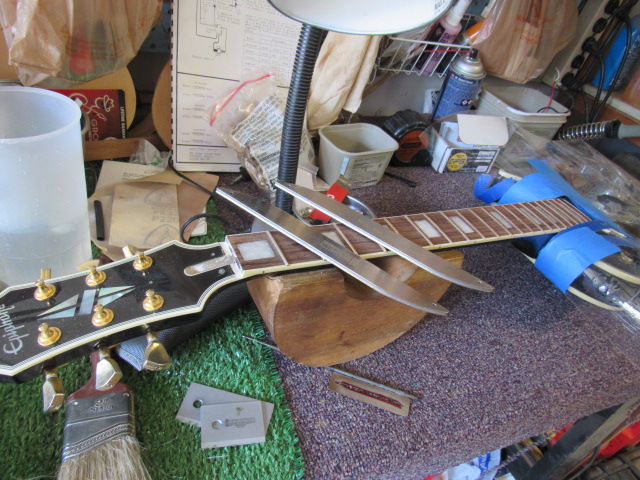
A step that I've found to be very important is to use a marker and mark the top of the frets. That way, when I am performing a fret dress I can see where my file is cutting.
Now if I were doing this on a maple fretboard I would tape up everything but the frets. Since this is rosewood I am just going to buff the snot out of it anyway. Some luthiers would tape up the fingerboard no matter what kind of wood was used. It's really just personal preference.
Also, please notice the plastic sheet that I use to protect the body. This works great. It's much better than laying down 1000 feet of masking tape like I've seen some luthiers do.
My next step was to fret-dress the frets. I'd use my fret file to even out the frets. Once they were flat, I used my "high tech" block of wood to sand it down even finer. I attached coarse 80 grit sandpaper with duct tape, and ran it back and forth on the frets.
Next up, I used a 150 grit diamond fret file, and then a 300 grit diamond fret file. I should also mention that I use my straight-edges repeatedly throughout this step. I have to be sure that the frets are as perfectly straight as can be.
After that, I used my "high tech" homemade block of wood. This time I attached 120 grit sandpaper to my block of wood with duct tape. Again, I ran the block of wood back and forth to make sure the frets were perfectly even. Again, I am using my straight-edges throughout this step.
Next up I used my fret shields while I sanded down and smoothed the frets. I like using 220 grit followed by 320, 400, and finally 600.
My next step used to be taking steel wool to the frets, but 3M has a new product that's much better and not as messy. They make these Scotch-bright pads that shine up the frets, but don't damage the wood. They also don't leave behind little pieces of steel wood that seem to magically attach themselves to your guitar pickups.
The gray one is equal to #00 steel wool, and the white one is equal to #0000 steel wool. See what a great job they do on the frets and fretboard?
The next step that I've found really makes a difference is using a buffer. Now I was going to use it anyway to buff out the guitar pick scratches, so this made it easy to just go over the entire guitar.
I used the three step buffing process, and it worked great.
After buffing the guitar out I checked the frets out with my straight-edges one last time. It measured perfectly flat. This would normally be the time where I would add some sort of oil to the fretboard. However, I kind of forgot this time around. So next time I change strings I will do that.
So next up was time to put the hardware back on, and install new pickups.
I decided to go with my favorite Schaller Golden 50 in the neck, and the Dean Leslie West, "Mountain of Tone" signature pickup in the bridge.
Once I installed them I had to set the guitar up. The big things to take care of were the string height, and adjusting/filing the nut slots. The intonation was perfect, and I only had to adjust the truss rod a little bit.
I have to say it feels good bring this guitar back to life. The "Mountain of Tone" pickup sounds a lot like a Seymour Duncan Custom 5. Which to me isn't that great. I never cared for the Custom 5, but this pickup sounds okay. I'll play it some, and see how I feel about it. But the lack of mids just make it seem like a weak pickup to me.
Next up I will be adding straplocks and a strap. Luckily I have some gold straplocks from years ago. I just never had a guitar to put them on until now. I'll end up playing this one for a while, and see how I feel about it. I'll see if I bond with it, or move it down the road. I will say I'm glad I had the chance to perform all this work on it. I think I enjoy working on them more than I do playing them these days.