I look at life a bit differently, and like to post my weird thoughts. I like musicial instrument repair and woodworking. For trying to live a somewhat normal life, a lot of weird things happen to me. Instead of putting up with it, I post about it in this blog.
For a while now I've been thinking about upgrading and overhauling my cello. My cello is a 1987, Model 360 Erich Pfretzschner. It was made in Romania when Romania was the China of Europe. So yeah, it's not the $5000 cello that they "recommend" for beginners, but most of my orchestral classmates played on what could only be described as "glorified cardboard."
Aside from one other cello, mine was the best of all my classmates for the entirety of my junior high and high school years. So I'd like to thank my parents for indulging a twelve year old's music career. I don't know too many other parents that would have done that.
In fact, over the years I've kept up with what they are selling for on the used market. It turns out that they have been losing value as time has gone on. I'm guessing fewer orchestra players and the flooding of Chinese instruments has lowered the value on all the violin family of instruments.
Still, it's been the only cello I've ever known. It was set up by a great luthier, William Walls of Tampa, Fl. My cello is still equipped with the bridge he made for me, as well as the endpin. So I really haven't planned on buying another cello. I just want to make sure this one is set up and upgraded.
Here's a photo of me playing it back in 1988.
So I have a three part plan on upgrading my cello. Or maybe it's a three stage plan? I used the word "stage" in my title.
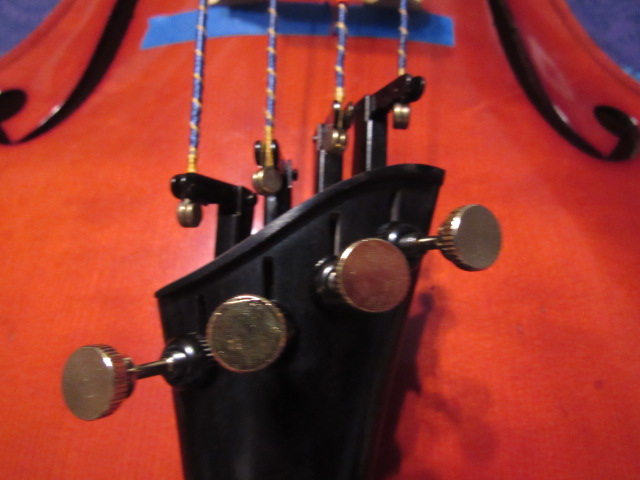
Step/Stage/Part One: I have replaced my tailpiece with a harp style Tailpiece. If you look at the photo from 1988, you'll see the original tailpiece. In all honesty, it was garbage. The second tailpiece, as you can see in the top photo, was gifted to me by my private cello tutor Laura Smith of the Florida Orchestra.
This one has served me well for over 30 years. However I thought it was time to upgrade to an ebony harp style tailpiece. Harp tailpieces are supposed to help cancel out wolf whistles. If you've ever heard a squeaky violin you know what I'm talking about. So I bought an ebony tailpiece from where ebony is grown, India. Thank you E-Bay. It cost me all of $12.
I bought gold fine tuners for it off E-bay as well. So I put it all together, and put it on my cello and noticed a problem. The tailpiece's edge came out too far. It wouldn't let the fine tuners adjust. So I thought about it for a while.
Finally I said to myself, "Hey, I'm a luthier. What if I just take it to my belt sander and sand the edge back? Then it would let my fine tuners move freely. I didn't immediately take photos. It wasn't until I had started sanding that I thought about grabbing my camera. Here's a photo after I had sanded a bit of the edge off.
Then I got to thinking again. I know, I talk to myself all the time. I just don't shut up. But I said, "Why take off just enough? If I take off more the fine tuners will have even more room to move." So I took off some more.
Now this works. I have to say, I'm glad I took more off. The tuners have a lot of room to move now.
So now it was time to string it up.
Now this is progress. I had to remind myself that not all universal parts are universal. But when you learn to work with what you have that's when you start to become great at what you do. It forces you to think outside the box.
So stay tuned for Stages two and three. Stage two should be soon. The part I have ordered for it is located here in Florida. So it shouldn't be too long before it gets underway. Stage three may be a month off. I had to order parts from China, and they can take a while to get here. Sometimes it can be as soon as ten days. Other times it can take six weeks. So stay tuned. More to come.
"If it's not Baroque, don't fix it!" Those words were said by one of my high school orchestra teachers, Mrs. Huthmaker. It was one of the few things she actually managed to teach me. That thought came to my mind many years after it was first said to me.
For fun I was looking through the cello section on E-bay when I saw something that I didn't recognize. That was good since I was searching for cellos that were not a typical Stradivarius or Guarneri. However, what I was looking at was in the cello section, but it was not called a cello. It was a Viola Da Gamba, a member of the Viol family.
I honestly had no clue what that was. I started playing cello when I was 12, and no one ever said anything about it. Wikipedia here I come.
Just to put this in perspective, the years from 1600 A.D. to 1750 A.D. are known as the Baroque period. One of Stradivarius' earliest known violins is from 1666. Some of his most "valued/sought after" violins are from 1680-1690.
What I am trying to say, Baroque music had been in full swing for almost a century before Stradivarius became known for producing his violins. So this leads to the question, what "violins" came before them? It turns out this:
So all those pictures I saw where the cello looked like it was melting and didn't have an endpin, well that was not so much "artistic license" was it was what a real viola da gamba looked like. Here's some vintage paintings and sketches.
It actually makes a bit of sense now doesn't it? The funny thing is that, I can't believe that I had to learn about this from E-bay off all places. Of course now I want to buy one, but ... what does it sound like. Let's pull up YouTube!
Okay, that's talent. I mean. That is talent. I don't even play seven stringed guitars, I wonder what I would do with a seven string bowed instrument?
Of course, the nice thing about the two Chinese instrument shops on E-bay is that they have what I would call a hybrid of a Strad style cello and a Viola Da Gamba. Here's a picture of the Viola Da Gamba on the left and a Strad style cello on the right.
Now here's what they were selling.
The shape is more consistent with the Viola Da Gamba, but it has a modern tailpiece, fine tuners, and very noticeably an end pin. Also, the angle of the fingerboard is a more modern shape.
One thing that can be changed for a truer, vintage sound is the strings. They still make gut strings as well as synthetic strings that sound like gut strings. Stringing those on this instrument would help towards a more Baroque sound.
So now, I have a few options. The two Chinese E-bay stores sell a variety of these Baroque era recreations. Some are very close to the original makes, others like the one above are hybrids. They also sell, "violins in the white," which means they are assembled but unfinished.
I would like to buy an unfinished hybrid. That way I could add the things I wanted. I could also stain it, and French polish (shellac) it instead of it coming with a heavy varnish. That's the one drawback to a lot of new instruments. They put on a heavier coat of finish than necessary. It ends up stifling the sound.
Since I would most likely want a four string hybrid, in the white Viol Da Gamba/Cello, I would consider almost making it a steampunk type instrument. It would have vintage stylings with modern attachments.
Let's start with the color. I could stain it wine red like all those Gibson Les Paul Customs. I would then finish it with shellac. Okay, I would be a little more artsy than that and French polish it, but either way, it's still putting shellac on a wooden instrument.
Next up, metal gears. That's right. They've had them for cellos for about a hundred years. Why not make use of them?
When it comes to tailpieces there are so many options. They make them in many types of wood, as well as a variety of styles. I even considered a brass tailpiece, but that would affect the tone. It might add a touch of brightness that I wouldn't want. Maybe not so much brightness, as a tinny sound. What I would really consider is a harp style tailpiece.
Another fun thing is that there are so many different pickup systems out there. I'm not sure where I would start. The costs are variable, but some of the nicer ones can get really pricey. I still have a lot of research to do on this.
Something else that would be quite modern is the use of a bone nut instead of an ebony one. Bone nuts have been used on guitars for a while, but not usually on orchestra instruments. I built one for my electric cello, and I am completely happy with it.
One thing they have now that they never had when I was a kid is a wolf whistle eliminator. Basically, a orchestra instrument will have overtones which are just awful. I mean the screechy howling sound that people hate when a kid first picks up the violin? Yeah, that's a wolf whistle. They now make a device to eliminate that sound. Where was this when I started out. It would have saved my parent's ears.
The one way to truly influence sound is find a good set of strings. For the longest time I didn't have a clue that good strings could change not only my tone, but my volume. Back when Mars Music was closing down I snagged a good deal on some D'Addario Helicores. They blew my mind. Before, all I knew was Red Label. I didn't know what some decent strings could do. The Helicores turned my tone up to 11, dang near doubled my volume, and bought out my bass notes.
I found out for electric orchestra instruments the Helicores tend to work the best for pickups and pickup systems. That's one reason I also put them on my electric cello. If I get a good deal on something else I may try them out. Especially if they are darker and/or warmer. But after having such good luck with the Helicores I will probably stick with them.
So I have a lot to think about. First up, finding a way to pay for it all. Right now it's just a pipe dream. But that's okay. I'm a bit of a daydreamer, and this is a good thing to daydream about. Let me think of what I would like to do, and keep a look out for new items being put up on E-bay. You never know what might come up.
And of course, the mandatory picture of me when I just received my cello. I was 12 in this photo.
I have been in a musical rut as of late. I have to admit to myself it is an annoying kind of funk. When I was in college, I would write my term papers deep into the night. Well, I like doing that with music too. However, try plugging in a guitar at 2 in the morning, and you will find out what your family really thinks of you.
I had something neat kind of happen though. I have a good friend Nick who shared a cheat sheet for musicians. It showed what chords you should play if you were in a certain key. A lot of my music is pretty simple 1-4-5 stuff, so I never really thought about music keys when playing guitar. So when Nick posted this chart it really opened my eyes.
Anyway, so I was messing around with the chord chart, and started playing basic chords in this order:
C, G, Am, Em. I liked where it was going. I use those chords a lot. Then I decided to use something that I never really did. I went with F since that's what the chart suggested. I felt that Em would be right after that. I felt that I was onto something, but was having trouble deciding what to do next. It was then I went back to F, and followed up with G. So try that this way:
C, G, Am, Em, F, Em, F, G.
I have having fun with it when I started to play it a certain way. It then hit me, I had just ripped off note for note the cello part of Canon in D. Yes. That Canon in D.
And here's my confession. I played cello in high school, and yes, I played Pachelbel's Canon in D. I felt like such a heal. Seriously, if you have a guitar by you, play those notes while listening to this:
This is really getting to me. I had the chords and rhythm picked out for both the verses and chorus. I had even started writing some lyrics. However, I have just stopped. I am just disgusted with myself. I'm just not sure where to go from here.
Back when I was twelve I started playing cello. It kind of surprised me how I really got into it, and started being really good at playing. Anyway, here's a picture of my cello. Yes, I still have it after all these years.
Anyway, there was one thing a bunch of twelve year olds with instruments liked to do, and that was rock out with their instruments. I mean, I dreamed of playing, George Throughgood's "Bad to the Bone" on my cello. (Sidenote: In all fairness, I was twelve.)
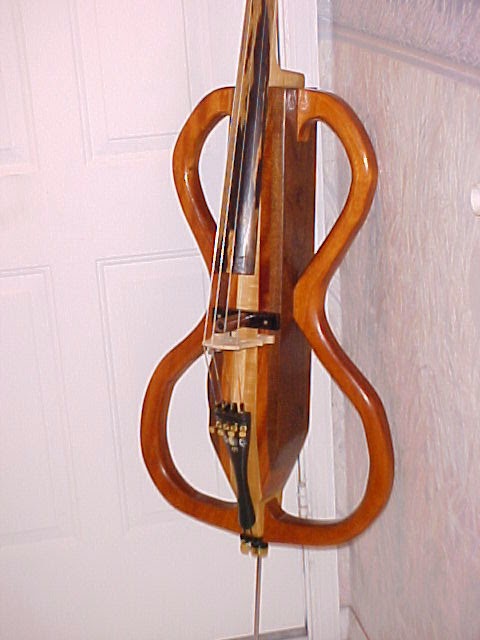
It got me to thinking, couldn't I have an electric cello? Well part of me answered that question later when I actually built an electric cello. True story. Here's the pics.
As awesome as that electric cello is, (and it is by the way,) it's not the kind you rock out with. When I was thinking about it in high school, I noticed the bass guitar had four strings, and played the lower notes like a cello did. However, the strings are actually backwards on a bass from a cello. Or, that's what I thought. I didn't realize that a bass is in 5ths, and a cello is in 7ths. It's just a matter of changing the size of the strings, and tuning to a cello's tuning A-D-G-C.
When I was researching this I was originally going to use a baritone guitar, so I would have a few extra strings. However, there are very few on the market that I like. It was then that I searched Musician's Friend for a "Short Scale" Bass.
I'm not very high on the cheaper basses, but I have to say one thing about the Fender Squier Short Scale Jaguar Bass. It has everything I want. It's short scale, it's in my price range, and it's also in a PJ configuration.
It seems the fates intervened and I found one locally on Craigslist from a guy not far from me. I think he had only played it twice or something. Here's a picture of it.
So here's what I have to do to make it perfect.
1. Fret dress. I gave it a rough set-up, but I can't get the action perfect until I put on the correct strings. I have found a few spots that need touched up on the high G string.
2. I already have a Seymour Duncan Quarter Pounder bridge J-bass pickup. So that baby is going in it.
3. I found a deal on a matching S.D.Q.P. P-Bass pickup. It's on it's way to the house, and should be here in a few days.
4. To make it all happen I really need the strings. Since the cello tuning is in 7ths, the string sizes are really far apart. They are .035, .055, .080, .125. So I am going to go to the music shop, and buy the individual strings since I can't buy them as a set.
5. I was given a strap with this bass, but I think I am going to grab another some time down the road.
But after that I think I will be set, and it will be time to practice. Of course I will want a bass amp, but that's down the road. I have my Sunn Alpha 2-12R for the time being.
So after all this time, I will finally have a cello that I will be able to rock out with. My inner twelve year old would be so proud.
As I am in the process of making my album, "This Divided Highway," I am continually bouncing ideas off of my friend/producer Josh. There has been a lot of discussion on what instruments to use. There have also been a lot of questions on what is considered "an instrument." But I'll get into that later.
I was telling Josh, that I was laying out the instruments for the songs like an orchestra is laid out. Here's a layout of an orchestra.
When I was in orchestra (high school, junior high,) it was only the violin family of instruments that was in orchestra. The brass, woodwinds, and percussion were considered to be "in band."
So I am approaching this record like the orchestra that I am familiar with. Here's how I have it laid out.
That's the basic layout. Then we get into added instruments. Some will appear on either one or a few tracks.
Piano = Piano
Percussion Section = Modern Day Drum Set
Flute = Flute (For solo)
Xylophone and/or flute = Old Timey Moonshine Jugs
Woodwinds = Electric Cello
Percussion = Shakers, Washboards, and other small handheld percussion instruments
Now that I have it written out, it makes a bit more sense. It seems a little more clean cut. After looking at all the instruments involved I am thankful for multi-tracking.
Now let me explain the jugs, and other odd instruments. Josh likes to take things that may not technically be instruments and incorporate them into music. Consider Appalachian music. They use things such as washboards, jugs, and saws (played with violin bows) in their music. Well, that's what he's doing. I'm okay with using some things. It really depends upon the song.
So that's what's happening so far. I'm feeling pretty good about it. I like to have things laid out when writing music, and this chart is working great for me.
I will keep updating as the album is being recorded.